
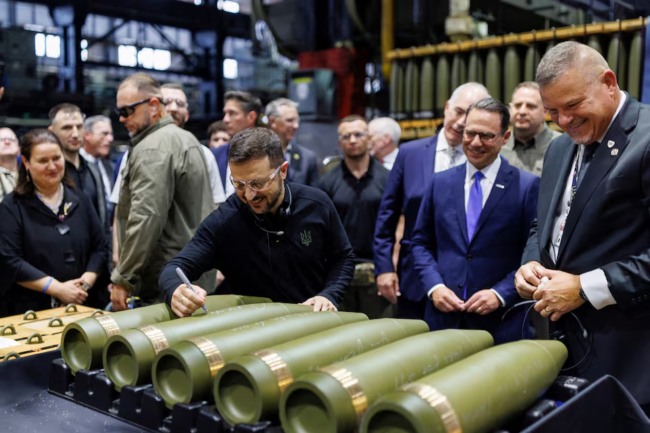
Ukraine’s President Volodymyr Zelenskiy visits the Scranton Army Ammunition Plant in Scranton, Pennsylvania. via Commonwealth Media Services
President Zelenskiy’s Visit to the United States to Present a “Victory Plan”
Ukrainian President Volodymyr Zelenskiy is scheduled to travel to the United States this week to unveil a “Victory Plan” aimed at securing support from his primary international ally. This visit is seen as a critical opportunity to influence U.S. policy on the war in Ukraine, regardless of the outcome of the U.S. presidential elections in November. Zelenskiy has indicated his intent to present this plan to President Joe Biden, along with his potential successors, Vice President Kamala Harris and former President Donald Trump.
Zelenskiy’s itinerary includes an address to the United Nations General Assembly on Tuesday, during which he will articulate his vision for a resolution to the ongoing conflict with Russia. He believes that if the plan garners Western support, it could exert psychological pressure on Russia, potentially motivating President Vladimir Putin to pursue a diplomatic resolution.
The Victory Plan and Its Objectives
The Victory Plan, according to Zelenskiy, outlines a series of rapid and concrete actions to be taken by Ukraine’s strategic partners between now and the end of December. Speaking to reporters on Friday, he described the plan as a “bridge” leading to a second peace summit, which Kyiv plans to organize later this year, with an invitation extended to Russia. Zelenskiy emphasized that peace is the only viable outcome, ruling out any pause in hostilities or temporary solutions that might allow Russian aggression to resume in the future.
Despite these efforts, significant differences remain between the two sides. Zelenskiy is seeking Ukraine’s inclusion in NATO and the European Union, along with the diplomatic withdrawal of Russian forces from all Ukrainian territories. In contrast, Putin has stated that peace talks would only be feasible if Ukraine abandons its NATO membership ambitions and cedes control of eastern and southern regions to Russia.
Political Implications of the U.S. Election
Zelenskiy’s visit comes at a crucial time for Ukraine, as the U.S. presidential election on November 5 could lead to a shift in Washington’s policy toward the conflict. Ukraine’s war effort is heavily dependent on U.S. military and financial assistance. A Trump victory could potentially lead to a reevaluation of this support, as Trump has refused to commit to supporting Ukraine in its efforts to defeat Russia. During a recent televised debate, Trump suggested he would attempt to end the conflict before assuming office, should he win the election. Harris, in contrast, has accused Trump of advocating for Ukraine’s rapid and unconditional capitulation.
In light of these political uncertainties, Ukraine has demonstrated its military capabilities through significant operations, including an incursion into Russia’s Kursk region on August 6, and the unveiling of advanced weapons such as drones and ballistic missiles. One notable attack last Wednesday resulted in an explosion at an ammunition depot in Russia’s Tver region. Meanwhile, Russia has escalated its own drone and missile assaults and bolstered its military forces with Iranian-supplied ballistic missiles, while intensifying its eastern offensive.
Strategic Focus on U.S. Support
U.S. National Security Adviser Jake Sullivan has confirmed that President Biden is eager to discuss Zelenskiy’s “comprehensive strategy for success” in Ukraine’s war with Russia. Zelenskiy, in turn, has emphasized that the success of his Victory Plan hinges on decisions made by Biden rather than by Putin. The plan includes securing Ukraine’s position within the global security framework, military decisions including operations like the Kursk incursion, strengthening Ukraine’s military capabilities, and shoring up the economy.
Military analyst Oleksandr Kovalenko has suggested that Zelenskiy will likely seek long-term assurances of U.S. aid through 2025 and possibly push for a declaration of continued support beyond the Biden administration. He noted that this could prove to be a politically and militarily pivotal moment for Ukraine.
It is anticipated that Zelenskiy will reiterate his request for authorization of long-range strikes into Russian territory, a move which Moscow has warned would lead to NATO countries being considered active participants in the conflict. Ukraine aims to target military installations up to 300 km (186 miles) inside Russia, including airfields used for launching attacks. However, the Biden administration has thus far refrained from easing restrictions on such strikes, deeming them unlikely to alter the battlefield dynamics significantly.
Current Situation on the Battlefield
Russia currently occupies approximately 18% of Ukrainian territory and has maintained offensive operations since October 2022. In August, Russian forces achieved their most significant territorial advances in recent months. Ukraine’s limited foothold in the Russian Kursk region could potentially serve as leverage in future negotiations or as a safeguard against external efforts to freeze the conflict along current frontlines. However, Kyiv faces substantial challenges in retaining control of this territory due to manpower shortages in the face of a much larger Russian force.
Meanwhile, Russian forces have made incremental progress toward the Ukrainian transport hub of Pokrovsk. Its capture could severely disrupt Ukrainian logistics and open up new avenues for Russian military operations. Kovalenko has speculated that Russia aims to seize Pokrovsk by the end of the year, which could intensify pressure on Kyiv to consider peace negotiations on Moscow’s terms.
Diplomatic Challenges and Future Peace Talks
Ukraine remains focused on advancing a peace framework through a second international summit, which is expected to take place later this year. Unlike the first summit held in Switzerland in June, which excluded Russia, Kyiv has signaled its willingness to invite Moscow to participate at the request of other attendees. The first summit also saw key absences from China and several countries from the Global South. Zelenskiy has repeatedly asserted that his summit initiative represents the only viable peace process. He recently criticized a joint Chinese-Brazilian proposal for conflict de-escalation as “destructive,” arguing that it does not require Russia to withdraw its forces from Ukraine.
As Ukraine prepares for its third winter in the ongoing war, the government faces a host of economic and logistical challenges, particularly following Russian strikes that have significantly reduced its energy infrastructure. The government has also announced its first wartime tax increases to address a $12.2 billion budget shortfall for defense spending this year.
Public Opinion and Future Prospects
Public opinion in Ukraine reflects a mix of resilience and pragmatism. According to polling conducted by the Kyiv International Institute of Sociology (KIIS) in May 2024, 32% of Ukrainians were open to the idea of making certain territorial concessions to end the conflict, an increase from 10% in 2022. However, most respondents envisioned a temporary deferral of territorial reclamation rather than a permanent cession of Ukrainian land. The most critical condition for any peace agreement remains firm security guarantees, including NATO membership.
Despite these challenges, Ukrainians continue to express optimism about the future, with widespread hopes that Ukraine’s future lies within the European Union and under the protection of robust security agreements.


COMMENTS