
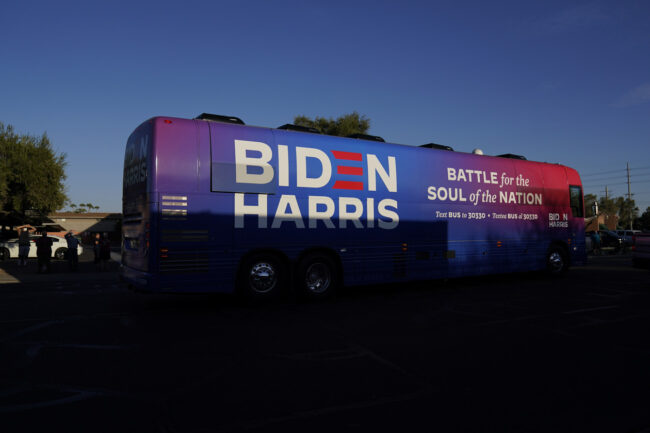
A jury in Austin, Texas began deliberations on Friday to determine whether the notorious “Trump Train” incident, in which a group of Trump supporters surrounded a Biden-Harris campaign bus days before the 2020 election, amounted to political intimidation. The case, which involves a civil lawsuit, has brought into question the actions of the Trump supporters who boxed in the bus on a Texas highway.
Political Intimidation or Free Speech?
The lawsuit was brought by Wendy Davis, a former Texas Democratic lawmaker and gubernatorial candidate, along with two others aboard the bus. They allege that the convoy of pickup trucks displaying Trump flags intentionally harassed and intimidated the bus occupants in a bid to suppress their political support for Joe Biden.
“This case is not about politics,” said Robert Meyer, the attorney representing those on the bus. “It’s about safety.” Meyer argued that the Trump supporters’ actions, which included surrounding the bus and forcing it to slow to a crawl, met the criteria for political intimidation. He pointed to the group’s coordination, which they called “Operation Block the Bus,” and aggressive driving tactics as evidence of their intent to intimidate.
Defense Claims Free Speech
However, attorneys representing the Trump supporters argue that their actions were protected under free speech, with no intent to harm or intimidate. Francisco Canseco, the attorney representing Eliazar Cisneros, who was accused of hitting a volunteer’s car, maintained that there was no plan to harm anyone. “There was no civil assault because there was no intent to hurt anybody,” Canseco said.
Testimonies and Heated Debates
The trial spanned two weeks and included testimony from Wendy Davis and several 911 calls from bystanders concerned about the safety of the convoy. Video footage from the bus shows the Trump supporters slowing down to box in the bus and occupying all lanes of traffic. Jurors also heard arguments that the convoy caused the Biden campaign to cancel its remaining events in Texas due to the lack of police response.
Ku Klux Klan Act and the Jury’s Decision
Plaintiffs’ attorneys argue that the actions of the Trump supporters violated the Ku Klux Klan Act, a federal law from 1871 that prohibits political violence and intimidation. While no criminal charges have been filed, the civil lawsuit seeks to prove that the convoy’s actions were a deliberate attempt to intimidate and suppress the Biden campaign.
The jury will now decide whether the Trump supporters made an informal agreement to intimidate, harass, or injure those on the bus, or if their actions were protected by freedom of expression.


COMMENTS