
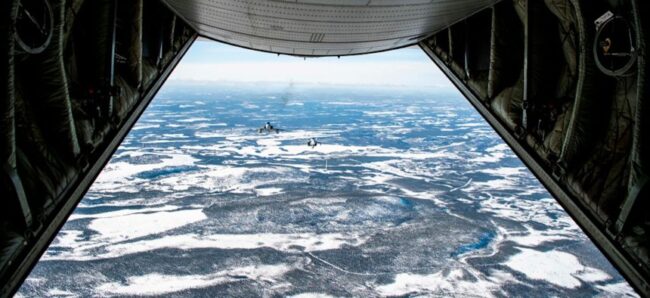
NATO is actively evaluating the establishment of a Joint Air Operations Center in the Arctic to boost its readiness and presence in the strategically crucial region, according to General James Hecker, Commander of the U.S. Air Forces in Europe and Africa. Hecker discussed the proposal at the Association of Aerospace Forces conference, highlighting the need for enhanced cooperation among Arctic nations in addressing emerging threats.
A third Joint Air Operations Center, in addition to the existing centers in Germany and Spain, has already gained initial support from General Christopher Cavoli, NATO’s Supreme Allied Commander Europe. While the plan remains in the preliminary stages, the initiative reflects NATO’s growing concern over Arctic security and the broader geopolitical landscape.
“We’re going to use the close relationship between the Arctic countries and the knowledge they bring to make this happen,” Hecker stated during a panel with representatives from the Swedish and Norwegian Air Forces. He emphasized the U.S. Air Force’s use of advanced reconnaissance technologies, such as MQ-9 Reaper and Global Hawk drones, to increase situational awareness in the region.
The Arctic as a Strategic Battleground
The Arctic is becoming increasingly important as melting ice opens new maritime routes and access to untapped resources. Global military powers, particularly Russia and China, are positioning themselves to capitalize on these opportunities. Russia, which holds the largest Arctic coastline, has been building military bases and conducting frequent military exercises in the region. This escalation, coupled with China’s self-proclaimed status as a “near-Arctic state,” has prompted NATO to reassess its strategy.
By establishing a Joint Air Operations Center, NATO aims to counter these activities by better coordinating air operations and improving its state of readiness. The Arctic holds significant strategic value due to its proximity to both North America and Europe. Given the increased presence of Russian and Chinese forces, NATO’s interest in securing the region is not just about resources but also about protecting its member states.
Countering the Russia-China-North Korea Bloc
NATO’s challenges are not limited to the Arctic. Russia and China have deepened their military and economic ties, conducting joint exercises near U.S. waters. North Korea’s inclusion in this axis adds to the complexity. The Russia-China-North Korea alliance strengthens their military capabilities and complicates NATO’s ability to respond to threats globally.
There are concerns that this alliance could expand further. Countries like Cambodia, Laos, Vietnam, and Afghanistan might join this coalition, creating a geopolitical bloc that stretches from Eastern Europe to Southeast Asia, challenging Western influence. Such an alliance would control critical shipping routes, energy resources, and military positions, giving it unprecedented power over global trade and security.
A Global Challenge Requiring a Global Response
NATO must evolve its strategy to counter the Russia-China-North Korea alliance and any potential future members. The establishment of an Arctic Joint Air Operations Center is a crucial step, but the alliance must also bolster military capabilities in strategic regions, increase intelligence-sharing, and strengthen cyber defenses to confront this growing threat.
While the Arctic initiative is critical, it’s clear that NATO faces a larger, global challenge. The formation of an authoritarian bloc could significantly reshape the global order, and NATO’s response in the Arctic must be part of a broader, coordinated strategy to preserve its influence.
Conclusion: A New Era of Competition
NATO’s potential move to establish an Arctic Joint Air Operations Center signals its recognition of a new era of global competition. The aggressive posturing of Russia and China, along with the potential for a larger authoritarian coalition, directly threatens the current global order. As NATO strengthens its Arctic presence, it must prepare for the long-term implications of these shifting geopolitical dynamics. The alliance’s actions in the coming years will be critical in shaping the future of global security.


COMMENTS