
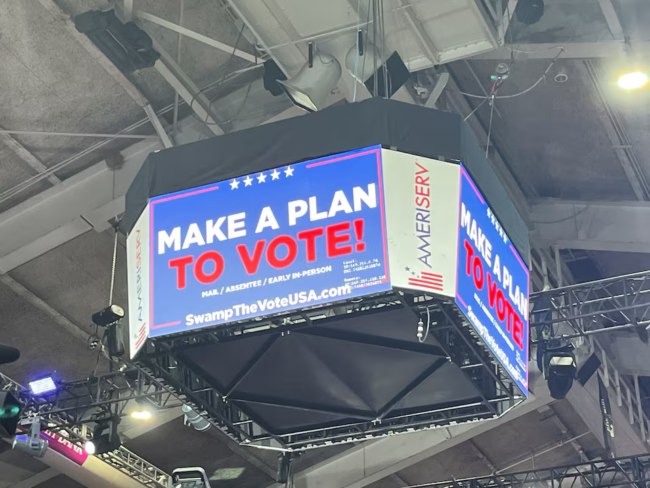
A view shows a jumbotron urging Trump supporters to make a plan to vote early or in-person on Election Day, during a campaign rally in Johnstown, Pennsylvania, U.S., August 30, 2024. REUTERS/Nathan Layne
Trump Campaign Focuses on Mobilizing Infrequent Voters in Key Battleground States
Strategic Efforts to Engage Infrequent Voters
In the lead-up to the November 2024 election, Donald Trump’s campaign has implemented a concentrated strategy to target infrequent voters, with Pennsylvania serving as a key state in this effort. Volunteers, such as Rachel and Chris Gottberg, have been actively canvassing in cities like York, Pennsylvania, with the goal of connecting with newly registered and “low propensity” voters—those who do not consistently participate in elections.
Wearing “Trump Force Captain” t-shirts, the Gottbergs and other volunteers have been door-knocking with a specific focus on these infrequent voters, who are seen as pivotal to Trump’s success in battleground states. This strategy marks a significant shift from the campaign’s approach in 2020 and is considered both high-risk and labor-intensive, as it aims to engage voters who may ultimately choose to stay home.
High-Risk, High-Reward Strategy
James Blair, the Trump campaign’s political director, emphasized the importance of getting these low-frequency voters to the polls. “We know they agree with us. We know they favor us, but we have to get them to the polls,” Blair said. The campaign’s efforts are particularly focused on rural, white, and younger voters, as well as a portion of people of color.
A recent New York Times/Siena College poll highlighted the potential of this strategy. While Trump leads Harris by just one percentage point among likely voters (48% to 47%), his lead grows to 49% to 40% among those who did not vote in 2020. This data underscores the campaign’s belief that turning out less-reliable voters is crucial for success.
Growing Infrastructure for Voter Engagement
The Trump campaign’s efforts are bolstered by several outside organizations, including the pro-Trump groups America PAC and Turning Point Action, which are specifically focused on mobilizing lower-frequency voters. These groups plan to spend millions on door-knocking initiatives in battleground states, aiming to reach voters through personal visits, calls, and post cards.
In contrast, some Republican officials have expressed concerns about the resource-intensive nature of this strategy. They worry that too much focus on infrequent voters could come at the expense of swing voters, who may be easier to persuade to turn out on Election Day.
Learning from Past Successes
The Trump campaign is drawing on lessons learned from the 2016 election and its successful approach in the Iowa Republican nominating contest earlier this year. The strategy relies on grassroots organization, with volunteers like the Gottbergs building relationships with potential voters in their neighborhoods. Trump campaign volunteers are asked to focus on a narrow group of individuals in their communities rather than casting a wide net.
The campaign hopes this targeted, personal approach will help win key battleground states like Pennsylvania, where turnout among conservative-leaning voters could prove decisive. According to Andrew Kolvet, a spokesperson for Turning Point Action, the margin of victory in battleground states can be razor-thin, making these voters critical to securing a win.
Democratic Campaign’s Broader Outreach
Meanwhile, Kamala Harris’ campaign is pursuing a broader-based strategy to capture a wider array of voters, including women and other groups not aligned with Trump. Harris has a larger paid staff in battleground states, with 1,600 workers compared to the hundreds of Trump canvassers. Harris’ team is focused on energizing voters through rallies, registration drives, and direct engagement with various demographic groups.
Despite the differences in strategy, both campaigns recognize the importance of winning key battleground states like Pennsylvania. With 19 electoral votes, Pennsylvania remains one of the most contested states in the election, and both Trump and Harris are deploying significant resources to secure a victory.


COMMENTS