
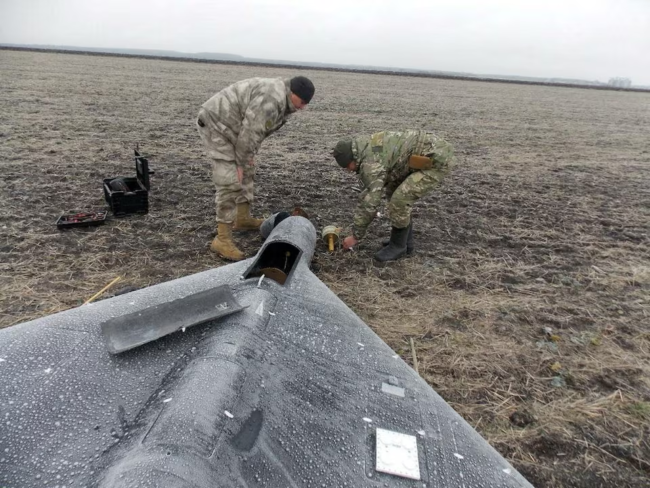
Members of police demining unit remove a warhead from a Russian kamikaze unmanned aerial vehicle landed by a radio electronic warfare during one of latest drone strikes, amid Russia’s attack on Ukraine, in an unknown location in Ukraine, in this handout picture released January 26, 2024. Press service of the National Police of Ukraine/Handout via REUTERS/File Photo
Deployment of Russian Garpiya Drone in Ukraine Revealed
A new long-range Russian drone, identified as the Garpiya-A1, has reportedly been deployed in Ukraine, targeting both military and civilian infrastructure. According to two European intelligence sources and documents reviewed by Reuters, the drone utilizes Chinese components and has caused significant damage to critical infrastructure, as well as civilian and military casualties. The existence of this drone had not been publicly reported before.
Manufacturing Details and Involvement of Chinese Technology
Russia began producing the Garpiya-A1 drone in 2023, utilizing engines and parts sourced from China. Intelligence reports indicate that over 2,500 units were produced between July 2023 and July 2024 by IEMZ Kupol, a subsidiary of the state-owned defense conglomerate Almaz-Antey. The intelligence documents, which include production contracts, internal company correspondence, and financial records, reveal the extensive role of Chinese technology in the drone’s development.
Images reportedly showing the wreckage of a Garpiya drone in Ukraine were shared with Reuters, though Reuters was unable to independently verify these photographs. Despite multiple attempts, IEMZ Kupol, Almaz-Antey, and Russian defense ministry officials did not respond to requests for comment. The Chinese government has reiterated its commitment to peace talks regarding Ukraine but did not address the specifics of Chinese technology being used in the Garpiya drone.
Shift in Russian Drone Manufacturing Strategy
The Garpiya represents a departure from Russia’s earlier reliance on Iranian drone technology. Samuel Bendett, a senior fellow at the Center for a New American Security, commented that this development suggests Russia is increasingly turning to domestic drone production, complemented by Chinese components. Russia had previously utilized Iranian-supplied Shahed “kamikaze” drones, which were instrumental in attacking Ukrainian infrastructure and exhausting air defenses. Iranian officials have consistently denied providing drones to Russia for the conflict.
Site of Drone Production and Chinese Component Suppliers
The Garpiya drones are produced at a facility located in Izhevsk, Udmurt Republic, in western Russia. The site, originally a cement factory acquired by Kupol in 2020, has been repurposed for drone manufacturing. Using imagery from a video posted on Telegram, Reuters was able to identify the facility by comparing it to known architectural features and satellite views of the region.
A contract signed between Kupol and the Russian Ministry of Defense in early 2023 outlined the establishment of a drone production plant valued at over 1 billion rubles (approximately 10 million euros). Chinese firms, including Xiamen Limbach, have supplied key components, such as Limbach L-550 E engines, for the production process. Correspondence and supply chain data reveal that Kupol procured large quantities of Chinese-made components through intermediaries like TSK Vektor.
NATO and International Concerns Over Chinese Support
NATO Secretary General Jens Stoltenberg has publicly urged China to cease supporting Russia’s war efforts in Ukraine. Intelligence reports expressed concern over the continued provision of Chinese components, which are critical to Russia’s ability to manufacture drones on a large scale. In response to similar international pressure, Beijing has stated that it strictly controls the export of dual-use items with potential military applications.
Chinese companies Juhang Aviation Technology and Redlepus Vector Industries, both based in Shenzhen, are cited as suppliers of parts essential for the production of Garpiya drones. Despite being subject to sanctions from the United States and the United Kingdom, these companies continued to export drone-related technologies to Russia.
U.S. and Chinese Responses to Allegations
While the United States has imposed several sanctions to hinder Russia’s access to military technologies, it has raised concerns over China’s continued involvement. The Chinese government, however, maintains that its trade with Russia is not subject to international restrictions. Starting in September 2024, Beijing announced plans to tighten its export controls on drones.
A production contract indicates that the Garpiya-A1 drone has a takeoff weight of less than 300 kilograms and a maximum range of 1,500 kilometers, specifications closely resembling Iran’s Shahed-136 drones. As the conflict continues, the role of Chinese components in Russia’s drone capabilities remains a point of contention among international observers.
Expansion of Russian Drone Production
Russia has increased its domestic production of drones, including a version of Iran’s Shahed-136, known as the Geran-2, at a facility in the Alabuga Special Economic Zone. Ukraine claimed responsibility for a drone strike against this production facility in April 2024. Despite this, production continues, with Russia manufacturing an estimated 2,500 Garpiya drones in the year following July 2023.
Customs records reviewed by Reuters reveal that Chinese firms, such as Juhang Aviation Technology and Redlepus Vector Industries, exported millions of dollars’ worth of drone components to Russia under the guise of “general civil use.” The intelligence community and international actors continue to voice concerns over China’s role in supplying materials for Russian drone manufacturing, which remains an ongoing issue in the Ukraine conflict.


COMMENTS