
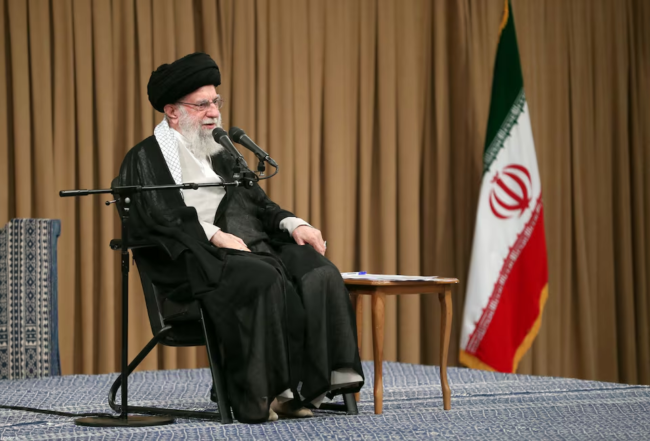
Iran’s Supreme Leader Ayatollah Ali Khamenei speaks during a meeting in Tehran, Iran, September 25, 2024. Office of the Iranian Supreme Leader/WANA (West Asia News Agency)/Handout via REUTERS/File Photo
Supreme Leader Khamenei Moved to Secure Location Amid Heightened Security Concerns
Sources have reported that Iran’s Supreme Leader, Ayatollah Ali Khamenei, has been relocated to a secure location within the country, following an Israeli airstrike in Beirut that resulted in the death of Hezbollah leader Hassan Nasrallah. The relocation, as reported by two officials briefed by Tehran, comes amid increased security measures in response to Israeli military actions against Hezbollah, a key ally of Iran in the region.
Heightened Security Measures in Iran
The decision to move Khamenei reflects a heightened sense of urgency within Iranian authorities. According to the reports, Israel has carried out several devastating strikes on Hezbollah, an organization closely supported by Tehran, further contributing to security concerns. Additionally, members of Iran’s Revolutionary Guards Corps (IRGC) were instructed to cease the use of communication devices after Israeli strikes targeted thousands of pagers and walkie-talkies used by Hezbollah operatives. Iran’s security forces have since intensified efforts to prevent further breaches in communications and potential infiltration by Israeli agents.
Iranian and Regional Responses to Nasrallah’s Death
Following the Israeli attack that killed Nasrallah, Iranian officials have been in contact with Hezbollah and other allied groups across the region, strategizing their next steps. Friday’s airstrike, which also resulted in the death of Abbas Nilforoushan, the deputy commander of the IRGC, has been perceived as a significant blow to Iran’s influence in the region. Other senior IRGC commanders have been killed since the eruption of the Gaza War last year, further impacting Iran’s leadership in the area.
Khamenei’s Response and Regional Implications
In response to the killing of Nasrallah, Ayatollah Khamenei issued a statement emphasizing the role of “the forces of resistance,” with Hezbollah positioned at the forefront of these efforts. Khamenei vowed that the death of Nasrallah would not go “unavenged,” and declared five days of mourning in honor of the Hezbollah leader. Nasrallah, who was instrumental in building Hezbollah into a major player within Iran’s regional alliance structure, will be remembered as a pivotal figure in the ‘Axis of Resistance’, which includes Hezbollah, Hamas, Iran-backed militias in Iraq, and the Houthis in Yemen.
The Broader Context of Regional Tensions
Iran’s network of regional allies has been significantly engaged in conflicts throughout the Middle East. Hezbollah has been involved in cross-border exchanges with Israeli forces since the Gaza conflict erupted in 2023. The Houthis, operating in Yemen, have launched missiles at Israeli targets and ships in the Gulf of Aden. Meanwhile, Hamas has been engaged in a protracted conflict with Israel following its October 7, 2023, incursion into Israeli territory. Hezbollah’s leadership had repeatedly stated that it would continue military operations until a ceasefire was achieved in Gaza.
Communications and Infiltration Concerns in Iran
Iran’s Revolutionary Guards have launched an investigation into potential infiltrations by Israeli intelligence following the strikes on Hezbollah’s communications infrastructure. An Iranian security official reported that a large-scale operation is underway to inspect all communications devices within the IRGC, including those sourced from China and Russia. Concerns have been raised about the possibility of Israeli agents within Iranian ranks, and thorough personnel reviews have begun, particularly targeting mid and high-ranking members of the IRGC.
Allegations of U.S. Involvement
Iranian President Masoud Pezeshkian also addressed the situation, accusing the United States of complicity in the killing of Nasrallah by supplying weapons to Israel. Pezeshkian, in a statement carried by state media, asserted that “the Americans cannot deny their complicity with the Zionists” in the recent strikes. This accusation underscores the broader geopolitical implications of the current conflict, where both Israeli and Iranian forces are deeply engaged in regional power struggles with international ramifications.


COMMENTS