
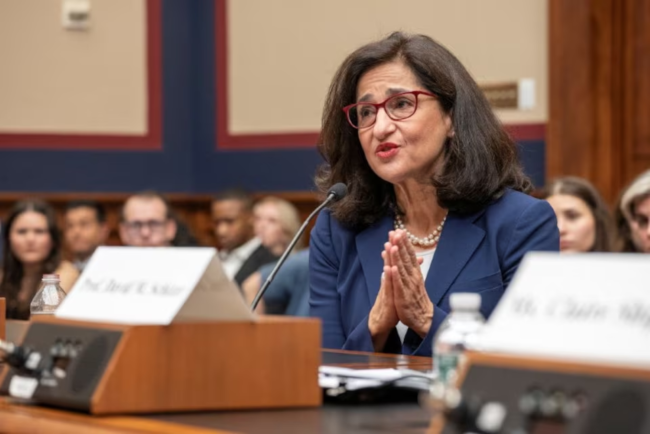
Columbia University President Nemat “Minouche” Shafik testifies before a House Education and the Workforce Committee hearing on “Columbia University’s Response to Antisemitism,” on Capitol Hill in Washington, U.S., April 17, 2024. REUTERS/Ken Cedeno/File photo
Columbia University President Minouche Shafik Resigns Amid Campus Protests Over Gaza Conflict
Resignation and Reasoning
On Wednesday, Minouche Shafik, President of Columbia University, announced her resignation, nearly four months after the university faced widespread criticism over its handling of campus protests related to Israel’s war in Gaza. Shafik cited the toll that the ongoing turmoil had taken on her family as a significant factor in her decision to step down. Her resignation marks the third such departure of an Ivy League university president following similar protests.
Shafik’s resignation is intended to allow new leadership to be in place before the new academic term begins on September 3. This timing is particularly crucial as student protesters have vowed to resume their demonstrations when classes recommence.
Background of the Campus Protests
In April and May, Columbia University became a focal point for protests against the deaths of Palestinian civilians in Gaza. The protests led to the occupation of parts of the campus and resulted in hundreds of arrests. The demonstrations placed Shafik in a difficult position, with both pro-Palestinian and pro-Israel groups criticizing her decisions. Pro-Palestinian groups condemned her for involving police to disperse the protesters, while pro-Israel supporters argued that she had not taken strong enough action to prevent the demonstrations.
Despite the criticism, Shafik defended her actions but ultimately acknowledged that the period of unrest had been challenging for the university community and her family.
Reaction and Interim Leadership
Following Shafik’s resignation, Columbia University announced that Katrina Armstrong, Dean of Columbia’s medical school, would serve as interim president. Armstrong recognized the challenges the university has faced and emphasized her commitment to guiding the institution through this difficult period.
Protest groups, including Columbia University Apartheid Divest, welcomed Shafik’s resignation but expressed concern that it should not distract from their broader goals, particularly their campaign to have Columbia divest from companies that support Israel’s military operations in Palestinian territories.
Broader Context and National Implications
Shafik’s resignation is part of a broader trend among Ivy League universities dealing with campus unrest over the Israeli-Palestinian conflict. Both Liz Magill of the University of Pennsylvania and Claudine Gay of Harvard have resigned following similar controversies. The issue has also attracted national attention, with U.S. Representative Elise Stefanik, a Republican, calling Shafik’s resignation “overdue” due to her perceived failure to protect Jewish students during the protests.
Shafik’s Future Plans
Minouche Shafik, who has held significant positions at the Bank of England, the London School of Economics, and the International Monetary Fund, plans to return to the British House of Lords. She will also chair a review of the UK government’s approach to international development.
Protests and Conflict Overview
The protests at Columbia were sparked by the latest escalation in the Israeli-Palestinian conflict, which began on October 7 when Hamas fighters attacked Israel, resulting in significant casualties and hostages. Israel’s subsequent military response has led to extensive loss of life and displacement in Gaza, raising international concerns and accusations of potential war crimes, which Israel denies.


COMMENTS