
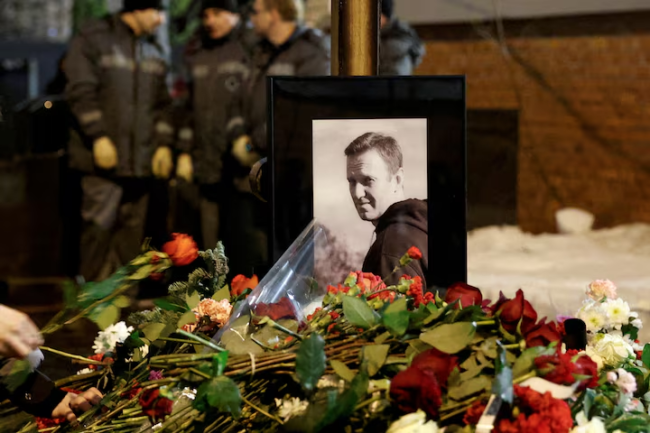
People lay flowers at the grave of Russian opposition politician Alexei Navalny following his funeral at the Borisovskoye cemetery in Moscow, Russia, March 1, 2024. REUTERS/Stringer/File Photo/File Photo
According to a report from the Wall Street Journal, U.S. intelligence agencies have purportedly concluded that it is unlikely Russian President Vladimir Putin directly ordered the death of opposition figure Alexei Navalny at an Arctic prison camp in February. Navalny, known as a prominent critic of Putin, passed away at the age of 47. His associates, labeled as extremists by Russian authorities, have accused Putin of orchestrating Navalny’s assassination and have pledged to furnish evidence supporting their claims. The Kremlin has consistently denied any involvement by the state in Navalny’s demise.
In a statement last month, Putin expressed regret over Navalny’s death and mentioned a willingness to exchange the detained politician with Western powers, provided Navalny refrained from returning to Russia. Allegations have surfaced suggesting discussions regarding such a prisoner exchange were underway prior to Navalny’s passing.
While the U.S. intelligence community reportedly does not attribute Navalny’s death directly to Putin, it has refrained from absolving him of broader responsibility, considering Navalny’s history of being targeted by Russian authorities, his imprisonment on what the West perceives as politically motivated charges, and the poisoning incident in 2020 involving a nerve agent. The Kremlin has consistently denied any state involvement in the 2020 poisoning incident as well.
Responding to the Wall Street Journal report, Kremlin spokesman Dmitry Peskov dismissed it as containing “empty speculation,” indicating a lack of credibility. Reuters was unable to independently verify the claims made in the Journal’s report, which cited sources indicating widespread acceptance of the U.S. intelligence assessment within the intelligence community, including entities such as the Central Intelligence Agency, the Office of the Director of National Intelligence, and the State Department’s intelligence unit.
The assessment reportedly relied on a variety of information sources, including classified intelligence, and an analysis of public information, such as the timing of Navalny’s death and its implications amidst Putin’s re-election in March. Leonid Volkov, a senior aide to Navalny, dismissed the U.S. findings as “naive and ridiculous,” according to the Wall Street Journa


COMMENTS