
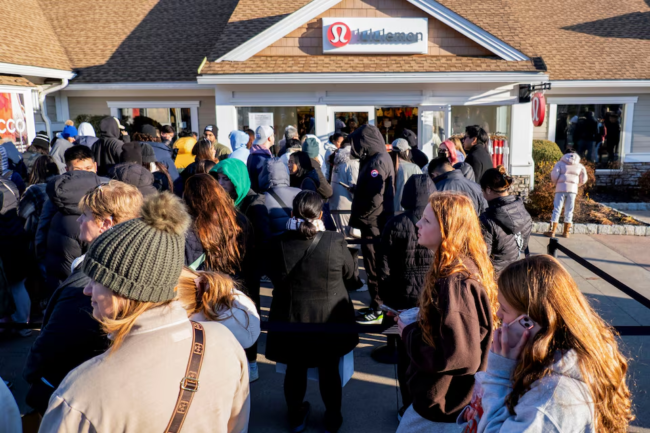
Black Friday shoppers stand in line for a Lululemon store as retailers compete to attract shoppers and try to maintain margins on Black Friday, one of the busiest shopping days of the year, at Woodbury Common Premium Outlets in Central Valley, New York, U.S. November 24, 2023. REUTERS/Vincent Alban/File Photo
In the latest report released by the Commerce Department on Thursday, it was revealed that the U.S. economy experienced a more robust growth than previously estimated in the fourth quarter of the preceding year. This growth was primarily driven by strong consumer spending and increased investment in nonresidential structures, such as factories and healthcare facilities.
Profits within the corporate sector saw a notable increase during the same period, largely attributed to nonfinancial corporations. The rise in profits, coupled with a simultaneous increase in worker productivity, is anticipated to foster an environment conducive to retaining employees and prolonging the ongoing economic expansion.
Despite concerns regarding a potential recession, stemming from the Federal Reserve’s implementation of 525 basis points worth of interest rate hikes since March 2022 to mitigate inflationary pressures, the economy has displayed resilience. Although momentum has somewhat slowed, the U.S. economy continues to outpace its international counterparts.
The Commerce Department’s Bureau of Economic Analysis, in its third estimate of fourth-quarter GDP, revised the annualized growth rate to 3.4%, up from the previously reported 3.2%. This upward revision was attributed to enhancements in consumer spending, business investment, and state and local government expenditure.

Moreover, the U.S. economy’s growth trajectory exceeds the 1.8% pace considered non-inflationary by Federal Reserve officials. Notably, GDP expanded at a rate of 4.9% in the July-September quarter and 2.5% throughout 2023, marking an acceleration from 1.9% in 2022. Forecasts for first-quarter growth hover around a 2.0% pace.
Inflationary pressures, as indicated by core inflation, exhibited a slight moderation last quarter, with the rate trimmed to 2.0% from 2.1%. Financial markets, as reflected in stocks on Wall Street and the performance of the dollar against a basket of currencies, exhibited relatively subdued activity ahead of the Good Friday holiday, while U.S. Treasury prices displayed mixed trends.
Consumer spending, a significant driver of U.S. economic activity, experienced an upward revision to a 3.3% growth rate, primarily attributed to increased spending on services. Additionally, business spending was revised upwards, particularly in manufacturing, commercial, and healthcare structures, as well as intellectual property products.
Inventory investment was adjusted downwards, subtracting from GDP growth, though prospects for the current year remain optimistic. Noteworthy contributions to growth last quarter were made across various industries, with nondurable goods manufacturing leading the way.
Corporate profits, inclusive of inventory valuation and capital consumption adjustments, saw a notable increase, particularly among domestic nonfinancial firms. The overall solid profitability suggests that businesses have maintained adequate financial stability entering 2024, which could potentially sustain spending through continued hiring.

Gross domestic income (GDI) also experienced robust growth, increasing at a rate of 4.8%, further indicating the favorable economic environment. Notably, the gap between GDP and GDI narrowed significantly, alleviating concerns regarding the accurate portrayal of the economy’s health.
A separate report from the Labor Department indicated a modest decrease in initial claims for state unemployment benefits, reflecting a more balanced labor market dynamics. The unemployment rate remained at 3.9% in February, with continuing claims displaying little change between survey periods.
Overall, the observed trends in economic indicators portray a picture of continued growth and stability within the U.S. economy, providing a foundation for cautious optimism moving forward.


COMMENTS