
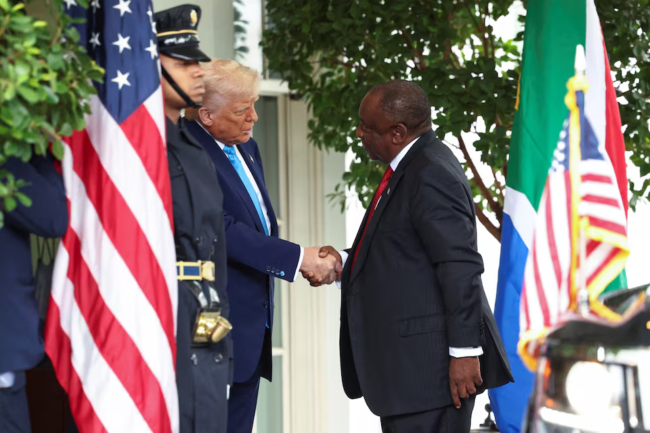
U.S. President Donald Trump welcomes South African President Cyril Ramaphosa to the White House in Washington, D.C., U.S., May 21, 2025. REUTERS/Kevin Lamarque
Trump Confronts South African President Ramaphosa With Claims of White Persecution Amid Trade Talks
WASHINGTON, May 21 (Reuters) — U.S. President Donald Trump confronted South African President Cyril Ramaphosa at the White House on Wednesday over unsubstantiated claims that white South Africans are being systematically killed and dispossessed of their land. The unexpected turn in the televised Oval Office meeting disrupted Ramaphosa’s intended agenda of discussing trade and critical minerals.
Disputed Allegations Overshadow Bilateral Talks
Ramaphosa arrived in Washington hoping to focus on expanding trade ties and securing favorable terms under Trump’s threatened “Liberation Day” tariff regime, which could impose a 30% tariff on South African goods. Initially, the meeting began cordially with light conversation about golf, with South African golf legends Ernie Els and Retief Goosen in attendance.
However, the tone swiftly shifted when Trump presented a video and printed articles that he claimed documented violence against white farmers in South Africa. The video featured white crosses said to be graves of white South Africans and clips of controversial speeches by opposition figures, including Julius Malema, whom Trump suggested should be arrested.
“People are fleeing South Africa for their own safety. Their land is being confiscated, and in many cases, they’re being killed,” Trump said while flipping through articles and repeatedly stating “death, death.”
South Africa Rejects Claims
President Ramaphosa responded calmly, stating that while crime in South Africa is a serious issue, the majority of victims are Black South Africans. South Africa has consistently rejected the narrative that white citizens are disproportionately targeted. He noted that the country’s new land reform law — aimed at correcting the legacy of apartheid — allows for expropriation without compensation only in limited public interest cases and with judicial oversight. No expropriations have yet taken place.
Trump interrupted Ramaphosa to say, “The farmers are not Black,” while the South African leader replied, “These are concerns we are willing to talk to you about.”
Despite the tension, Ramaphosa maintained his composure throughout the exchange. South African billionaire Johann Rupert, part of the delegation, supported Ramaphosa by emphasizing that crime affects all South Africans and that many Black citizens are victims as well.
U.S.-South Africa Tensions Grow
Trump has recently escalated criticism of South Africa’s domestic and foreign policies, including its land reform efforts and its genocide case against Israel at the International Court of Justice. His administration has cancelled aid, expelled South Africa’s ambassador, and offered refuge to white Afrikaners citing alleged racial discrimination — a claim Pretoria has dismissed as baseless.
Despite the controversy, Ramaphosa aimed to steer the discussion back to cooperation. Elon Musk, the South Africa-born U.S. tech entrepreneur and Trump ally, was also present. Rupert used the opportunity to advocate for Musk’s Starlink satellite system, suggesting it could support crime-fighting efforts by improving communications infrastructure for South African police.
Strategic Relations at Risk
The United States is South Africa’s second-largest bilateral trading partner after China. With the threat of steep tariffs looming, Pretoria is seeking to stabilize relations. However, Wednesday’s confrontation revealed widening diplomatic tensions that could complicate future cooperation on both economic and geopolitical issues.


COMMENTS