
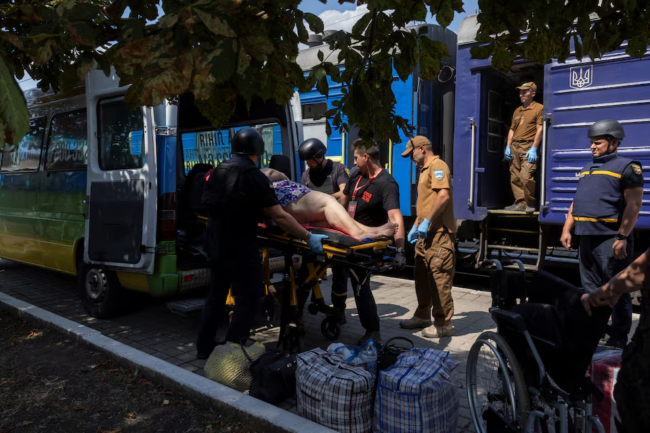
Volunteers of East SOS evacuate a woman, as Russian forces advance across the frontlines in the Donetsk region, at the train station in Pokrovsk, Ukraine, amid Russia’s attack on Ukraine, August 2, 2024. REUTERS/Thomas Peter
Russian Assaults Escalate Pressure on Eastern Logistics Hub of Pokrovsk
Russian military operations are intensifying around the strategic eastern logistics hub of Pokrovsk, Ukraine, according to statements made on Friday. The combined use of guided bombs and infantry has resulted in some of Moscow’s most significant territorial gains since the spring.
This escalation has prompted a substantial increase in civilian evacuations, with requests for assistance rising approximately tenfold over the past fortnight, as reported by a local volunteer. Russian forces have been making gradual advances on multiple fronts within the eastern Donetsk region, launching particularly aggressive attacks near Pokrovsk. Ukrainian forces, now stretched thin 29 months into Russia’s full-scale invasion, are facing increased pressure.
According to Pasi Paroinen, an analyst with the Black Bird Group, Russian forces have secured approximately 57 square kilometers (22 square miles) over the past week, marking their third-largest gain since April, following only minor advances in June. Ruslan Muzychuk, a spokesperson for Ukraine’s National Guard, indicated in televised remarks that Russian forces are utilizing warplanes and artillery to support these infantry assaults, particularly near Pokrovsk.
“These assaults are not consistently supported by armored vehicles; often they are infantry-led,” Muzychuk noted, emphasizing the significant threat posed by Russian aerial bombardments on Ukrainian defensive positions in the Pokrovsk and Toretsk areas.
The Russian Ministry of Defence reported the capture of five settlements within the Donetsk region over the past week. Valeriy Romanenko, a Kyiv-based aviation expert, highlighted the strategic importance of Russia’s use of warplanes to deploy guided bombs, describing it as a “conveyor belt” tactic. This approach involves repeated cycles of bombing followed by infantry assaults.
Romanenko suggested that the introduction of U.S. F-16 fighters to Ukraine’s arsenal could potentially alter this dynamic by threatening Russian warplanes, though he acknowledged that such operations are currently improbable due to the risks posed to inexperienced pilots operating high-value aircraft.
Paroinen further commented that Russian offensives near the settlements of Toretsk and Niu York, as well as to the east of Pokrovsk around Ocheretyne and Prohres, have created a “double crisis” for Ukrainian forces. This situation, he noted, emerged following a halted Russian offensive in the northeastern Kharkiv region, which nevertheless opened a new front and further strained Ukrainian defenses.
The humanitarian impact of these operations is significant. Roman Buhayov, an evacuation driver for the humanitarian organization East SOS, reported a tenfold increase in evacuation requests in the affected areas over the past two weeks. On Friday, Buhayov facilitated the evacuation of residents from Novohrodivka, a town with a pre-war population of approximately 14,000, now situated about 10 km from the advancing front line.
Among those evacuated was Antonina Kalashnikova, 62, and her disabled son Denys, 34. They traveled to Pokrovsk with their neighbor, carrying their remaining possessions in a few market bags, before continuing to the southern city of Mykolaiv.
Kalashnikova recounted the severity of the situation: “The bombing became extremely intense and frightening. We did not sleep all night and decided to leave. They are destroying everything.”


COMMENTS