
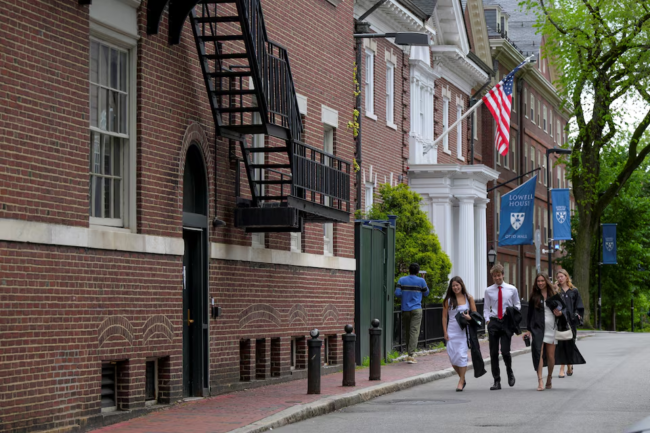
Students walk on the campus of Harvard University in Cambridge, Massachusetts, U.S., May 23, 2025. REUTERS/Faith Ninivaggi
Trump Administration Moves to Bar Foreign Students at Harvard Over China Ties; Court Issues Temporary Block
WASHINGTON, May 24 (Reuters) — The Trump administration has escalated its confrontation with Harvard University, moving to revoke the school’s ability to enroll foreign students. Officials cited allegations of antisemitism and influence operations linked to the Chinese Communist Party (CCP), particularly through academic and research ties with China.
A federal judge in Boston temporarily blocked the administration’s order on Friday after Harvard filed a legal challenge, arguing that the move infringes upon constitutionally protected free speech rights under the First Amendment.
Administration Targets Alleged Chinese Influence
The White House accused Harvard of enabling Chinese state-backed activities on campus, including surveillance, harassment, and intellectual property appropriation. “For too long, Harvard has let the Chinese Communist Party exploit it,” a senior administration official told Reuters, claiming the university “turned a blind eye to vigilante CCP-directed harassment on-campus.”
While the university has not issued an immediate comment, it has previously argued that the administration’s action constitutes retaliation for “perceived viewpoints” and undermines academic freedom.
Foreign Students in the Crosshairs
Chinese nationals made up around 20% of Harvard’s foreign student cohort in 2024, and the broader foreign student population is a significant source of academic and financial strength for the university. Critics say the administration’s move to revoke the school’s ability to admit foreign students risks harming U.S. global leadership in education.
Former Harvard President Larry Summers described the decision as “the most serious attack on the university to date,” warning it could serve as a “strategic gift” to China by undermining America’s role as a global academic leader.
Accusations Echo Congressional Concerns
Concerns over Chinese state influence at Harvard have long circulated among U.S. lawmakers, particularly within the Republican-led House Select Committee on China. Citing national security and human rights concerns, the Trump administration pointed to multiple episodes as grounds for punitive action:
- Public Health Collaboration with XPCC: Harvard provided training to officials from the Xinjiang Production and Construction Corps (XPCC), a paramilitary organization sanctioned by the U.S. since 2020 for alleged abuses against Uyghurs. DHS claims these interactions continued through 2024.
- Donor Links to Chinese Interests: Ronnie Chan, a Hong Kong businessman who facilitated a $350 million donation to Harvard in 2014, is affiliated with the China-United States Exchange Foundation—a group registered as a foreign principal under U.S. lobbying law.
- Campus Surveillance Allegations: In 2024, a Chinese student physically ejected a student activist during a Harvard event featuring China’s Ambassador Xie Feng, sparking concerns about informal enforcement of CCP positions on U.S. campuses.
Lieber Case and the China Initiative
The Trump administration also cited the case of former Harvard professor Charles Lieber, who was convicted in 2021 of lying about Chinese funding for his research. Lieber’s case was part of the Trump-era “China Initiative,” a now-defunct program aimed at combating Chinese espionage, which was criticized for encouraging racial profiling and undermining academic exchange.
Lieber, who recently accepted a full-time professorship at a Chinese university, was used by administration officials as a symbol of deeper concerns about unchecked academic collaboration with China.
Human Rights and Policy Concerns
While acknowledging legitimate concerns about espionage and authoritarian overreach by Beijing, some experts and rights advocates criticized the administration’s blanket approach.
Yaqiu Wang, a U.S.-based human rights researcher originally from China, called the revocation of Harvard’s foreign student authority “completely counterproductive.”
“Concerns over transnational repression and espionage are legitimate,” Wang said, “but to try to address that by banning, not only Chinese students, but foreign students, is just beyond comprehension.”
Ongoing Legal and Political Uncertainty
The Department of Education in April demanded that Harvard provide full documentation of its foreign funding after identifying what it described as incomplete disclosures.
While the temporary court order protects foreign students for now, Harvard’s legal challenge is expected to trigger a high-profile battle over the limits of federal authority in higher education and national security policy.
The outcome may also set precedent for how academic institutions navigate rising geopolitical tensions between Washington and Beijing amid intensifying scrutiny of cross-border academic collaboration.


COMMENTS