
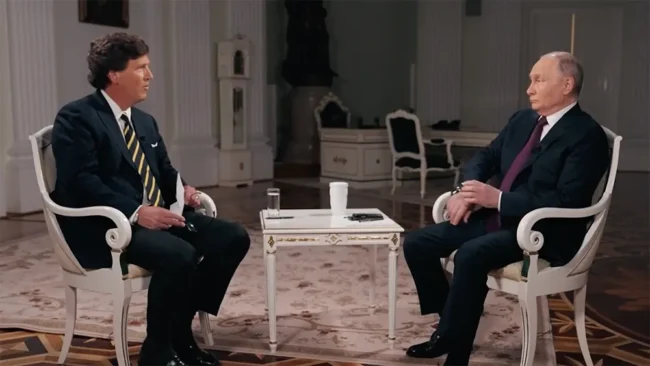
In a move that has sparked widespread debate, Tucker Carlson’s recent interview with Russian President Vladimir Putin is being scrutinized for its potential implications. The interview, characterized by Carlson as an attempt to present Russia’s perspective on the global stage, is raising questions about whether it signifies journalistic success or a propaganda triumph for Putin.
Carlson’s Allegations and Kremlin’s Response
Media Bias and Lack of Interviews
Tucker Carlson claimed that major U.S. media outlets had refused to interview Putin since the invasion of Ukraine, accusing them of bias and corruption. He labeled Western media as “corrupt” and accused them of ignoring Russia’s perspective.
Kremlin’s Denial
Contradicting Carlson’s claims, Kremlin spokesman Dmitry Peskov stated that the Kremlin receives numerous interview requests for Putin. While acknowledging routine rejection of requests from major Western outlets, Peskov emphasized that Carlson’s position was different, justifying the decision to grant the interview.
Analyzing Putin’s Strategic Play
Building Bridges with MAGA Element
Observers note that the Kremlin’s decision to allow the interview reflects Putin’s interest in building bridges with the disruptive MAGA element of the Republican Party. It aligns with the Kremlin’s hope for Donald Trump’s return to the presidency and opposition to U.S. military aid to Ukraine.
Impact on U.S. Presidential Race
The interview is seen as a strategic move by Putin to influence the U.S. presidential race. By reinforcing ties with pro-Trump Republicans, the Kremlin aims to promote a false narrative about Ukraine, weaken President Biden, and strengthen Trump’s political position.
Media Preferences and Carlson’s Position
Kremlin’s Favorable View of Carlson
Peskov expressed a preference for Carlson’s approach over major Western media, accusing the latter of bias. Describing Carlson as “pro-American,” the Kremlin sees his position as different from the one-sided stance of established Western outlets.
Potential Bias in Carlson’s Alignment
While Carlson claims to present Russia’s perspective, critics argue that his alignment with Kremlin propaganda on Ukraine raises questions about potential bias and the interview’s overall impact.
Public and Political Reactions
Divided Opinions on Journalistic Success
The public and political figures remain divided on whether Carlson’s Moscow interview signifies a journalistic success, providing a platform for diverse perspectives, or a propaganda triumph, amplifying Putin’s narrative without critical scrutiny.
Impact on U.S.-Russia Relations
Analysts are closely monitoring how the controversial interview may impact U.S.-Russia relations, especially as it coincides with critical developments in the ongoing conflict in Ukraine.
Conclusion: A Complex Evaluation
As discussions intensify, the Carlson-Putin interview prompts a complex evaluation of journalistic ethics, media dynamics, and the geopolitical implications of providing a platform for leaders with contentious narratives. The debate continues on whether this encounter is a journalistic success or a propaganda triumph orchestrated by Putin.


COMMENTS