

Bansal Oreus helps other Haitian immigrants with government documents at the St. Vincent de Paul Society in Springfield, Ohio, U.S., August 15, 2024. REUTERS/Howard Schneider/File Photo
The Impact of Haitian Immigration on Springfield, Ohio
Migration Patterns and Economic Revival
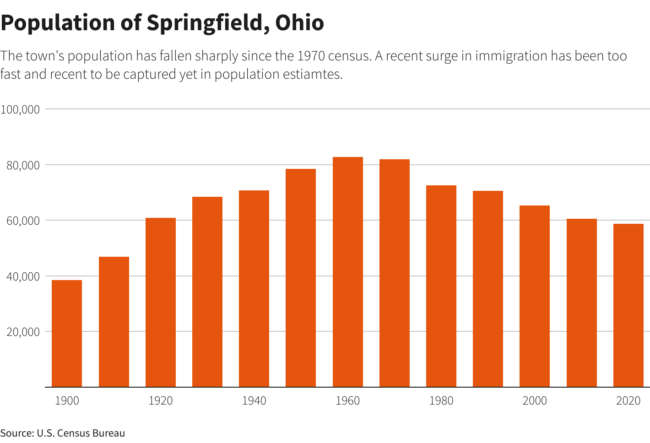
Rose Joseph and Banal Oreus are part of a wave of Haitian immigrants reshaping Springfield, Ohio, a Midwestern industrial city at the heart of the U.S. presidential race. Joseph arrived in 2022 after escaping violence in Haiti and settling in Florida, drawn to Springfield by the promise of job opportunities. Oreus, after living in Brazil, Portugal, and Mexico over eight years, followed family and friends to Springfield in 2023. Their journeys are emblematic of the roughly 15,000 Haitians who have moved to the city in the last three years, contributing to its economic revival while also highlighting social tensions.
Population Growth and Economic Impact
The influx of Haitian immigrants has had a profound effect on Springfield’s economy, which had struggled after decades of industrial decline. Data shows that the population growth has spurred some economic recovery, but has also led to challenges. Increased demand for housing caused rents to surge by 14.6% annually between 2022 and 2023, though rent growth has since slowed. Wage growth, driven by the need for workers, rose by more than 6% annually for two years, but has now slowed to 1.1% as the labor market cools.
Despite these changes, Springfield’s growth offers long-term promise. According to Mayor Rob Rue, a growing population “could absolutely have a long-term benefit,” though he acknowledges the city is currently navigating a “rocky season” with housing shortages, rising rents, and strained public services.
Political and Social Tensions
The rapid influx of Haitian immigrants has made Springfield a flashpoint for national debates on immigration, the economy, and race. Republican candidate Donald Trump and his running mate JD Vance have amplified false claims about crimes and atrocious acts allegedly committed by Haitian immigrants, including unsubstantiated rumors of pet-eating in Springfield. Local officials, including the police, have firmly refuted these allegations, stating that “there have been no credible reports” of such activities.
At the same time, Springfield has seen tension rise as a small group of white supremacists marched during a local jazz festival, and city commission meetings have been marked by rhetoric critical of immigration. Vance has also claimed that immigration has led to higher housing costs and suppressed wages, though Federal Reserve Chair Jerome Powell countered that immigration has helped grow the economy and slow inflation overall.
Challenges and Opportunities
Springfield’s housing challenges predate the arrival of Haitian immigrants, with years of underinvestment and lax code enforcement leaving many homes vacant or in disrepair. The increased population has exacerbated the housing shortage, and the city is now working to address these issues. New housing developments are underway, with a Ryan Homes subdivision nearing completion and additional projects planned for higher-priced homes and city-center townhomes.
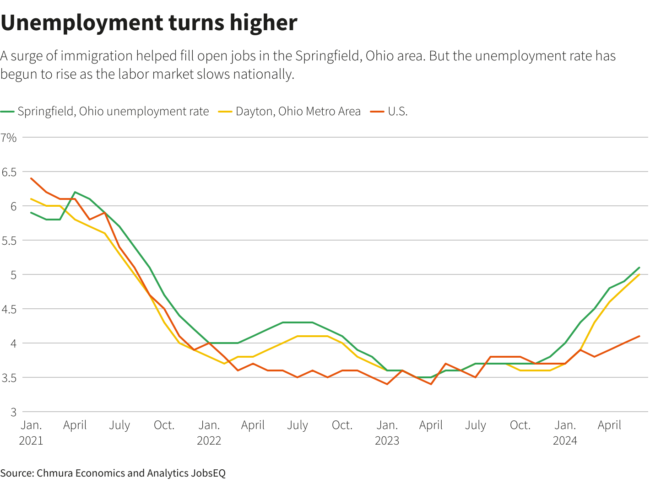
While the city’s unemployment rate has begun to rise, job openings remain strong. Many local businesses, particularly in the manufacturing and warehouse sectors, view the growing population as essential for filling job vacancies. Amy Donahoe, director of workforce development with the Greater Springfield Partnership, emphasized that the Haitian immigrants “are working hard and they want to make money,” highlighting their importance to the city’s economic revival.
The Path Forward
As Springfield adapts to the recent influx of immigrants, city officials are working to mitigate the short-term disruptions. Efforts include finding additional funding for public services, hiring translators, and providing support to new arrivals through community organizations. Local leaders believe that once these challenges are addressed, the city will benefit from the increased population and the accompanying economic activity.
Joseph and Oreus, like many other immigrants, are finding their place in Springfield, contributing to the economy and building new lives. Joseph works at an Amazon warehouse and helps staff a local Haitian cultural center while pursuing a degree in social work. Oreus, who works at a local manufacturer and helps new immigrants navigate the legal and bureaucratic challenges they face, was drawn to Springfield by the presence of family and friends who had already settled in the area.
For Springfield, the arrival of Haitian immigrants marks both a period of transformation and a potential for renewal. Despite the growing pains, the city’s leaders are optimistic that a larger workforce and a revitalized population can help restore its economic vitality.


COMMENTS