
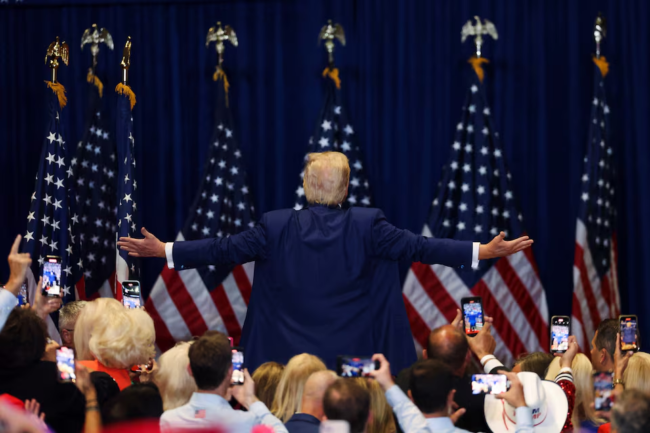
Republican presidential nominee and former U.S. President Donald Trump gestures during a rally at Nassau Veterans Memorial Coliseum, in Uniondale, New York, U.S., September 18, 2024. REUTERS/Brendan McDermid
Trump Campaign Files Lawsuits Over Alleged Non-Citizen Voting Ahead of U.S. Presidential Election
Overview
As the 2024 U.S. presidential election nears, former President Donald Trump and his Republican allies are intensifying legal efforts that allege widespread non-citizen voting. These lawsuits challenge voter registration procedures in critical battleground states, including Arizona, Michigan, and Pennsylvania. Democracy advocates argue that these legal actions are designed to undermine trust in the electoral process and lay the groundwork for contesting potential losses.
Claims of Non-Citizen Voting
At least eight lawsuits have been filed, focusing on the citizenship status of voters and alleging that non-citizens have illegally registered to vote. Trump’s legal team claims these actions are necessary to protect election integrity. However, independent studies consistently show that non-citizen voting is exceedingly rare and unlikely to impact election outcomes.
A study conducted by the Brennan Center for Justice found only 30 instances of non-citizen voting among 23.5 million ballots cast in the 2016 presidential election, accounting for a negligible 0.0001% of the vote. Despite this, Trump’s legal team argues that even a single illegally cast vote is too many.
Legal and Political Context
While Trump and his allies argue their lawsuits defend against potential voter fraud, legal experts contend that the claims lack substantial evidence. The lawsuits aim to challenge voter rolls and registration practices in states where the outcome could be closely contested, such as Arizona, Georgia, and Michigan. Critics, including the U.S. Department of Justice, assert that federal law prohibits significant changes to voter registration processes within 90 days of an election, making these suits more of a political strategy than a legitimate legal effort.
New Mexico Secretary of State Maggie Toulouse Oliver described Trump’s tactics as an attempt to create a “rigged election” narrative in the event of a loss. Similar to his previous election campaigns, Trump appears to be setting the stage for post-election challenges should the results not be in his favor.
Political Responses and Legal Strategy
While national opinion polls show Vice President Kamala Harris with a slight lead over Trump, the race remains tight in key swing states. If Harris were to win by a narrow margin in one or more battleground states, a successful legal challenge by Trump could be enough to contest the results.
Republican attorneys and groups aligned with Trump have filed lawsuits against state election boards, accusing officials of failing to prevent non-citizens from registering to vote. In Arizona, a lawsuit filed by the America First Legal Foundation seeks to investigate approximately 44,000 voters who registered without providing proof of citizenship.
While the public rhetoric from Trump’s camp suggests widespread fraud, legal experts note that the language used in the court filings is more cautious. In most cases, the lawsuits acknowledge that instances of non-citizen voting are rare, but argue that vigilance is necessary to prevent future issues.
Historical Context
Trump’s legal strategy closely mirrors his efforts in the 2020 election, where more than 60 lawsuits were filed to contest President Joe Biden’s victory. Nearly all of those lawsuits were dismissed due to lack of evidence. Many observers argue that this year’s lawsuits are part of a broader public relations campaign to sow distrust in the electoral process rather than a legitimate effort to prevent voter fraud.


COMMENTS