
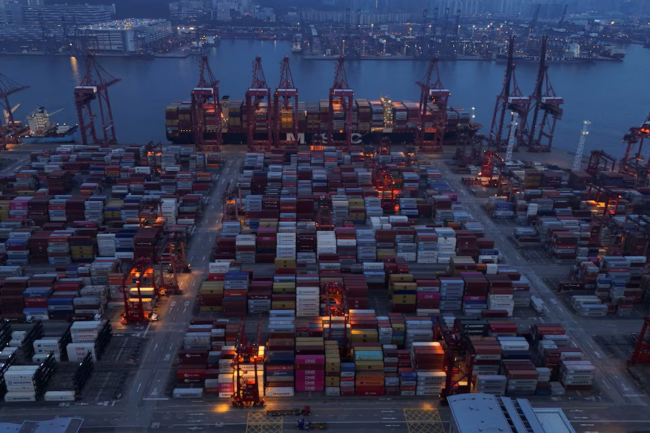
A general view shows container terminal in Hong Kong, China, April 23, 2025. REUTERS/Tyrone Siu/File Photo
China Quietly Creates Tariff Exemption List for U.S. Goods Amid Trade Tensions
May 1, 2025
China has developed a confidential list of U.S.-manufactured products that will be exempt from its 125% retaliatory tariffs, according to two individuals familiar with the matter. The move signals an effort by Beijing to mitigate the domestic economic impact of its prolonged trade dispute with the United States while maintaining a firm public stance.
Selective Concessions Under the Radar
While China has previously granted exemptions for specific goods such as pharmaceuticals, microchips, and aircraft engines, this is the first known indication of a broader, organized “whitelist” of tariff-exempt products. The existence of the list has not been publicly announced, and Chinese authorities have not released its contents.
Companies are reportedly being informed privately by government officials. One source, an employee of a pharmaceutical firm that sells U.S.-made medicines in China, said the company was contacted by the Shanghai Pudong government earlier this week. The company had previously lobbied for tariff exemptions due to its reliance on U.S. technologies.
“We still have many technologies we need from the U.S.,” the source said.
Another individual noted that some companies have been encouraged to reach out discreetly to local authorities to determine if their imports may qualify for tariff relief.
Expanding List of Exemptions
Recent reports suggest that the scope of the exemptions is expanding. On Tuesday, Reuters reported that China had removed tariffs on U.S. ethane imports, a critical commodity for which the U.S. is the sole global supplier. Ethane processors in China had already been seeking exemptions due to the absence of viable alternative sources.
The quiet rollout allows Chinese authorities to extend concessions without altering the government’s official posture. Beijing has consistently maintained that it is prepared to continue the trade standoff unless Washington lifts its 145% tariffs on Chinese goods. However, the behind-the-scenes exemptions suggest a more pragmatic approach aimed at preserving key economic interests.
U.S. Optimism on Trade Deal Prospects
U.S. President Donald Trump commented on Tuesday that a trade deal with China may be forthcoming. “But it’s going to be a fair deal,” he added, without elaborating on specific conditions or timelines.
Chinese government agencies, including the Ministry of Commerce and the General Administration of Customs, did not immediately respond to media requests for comment.
Assessing Economic Impact
In parallel with the exemptions, Chinese officials are surveying businesses to better understand the effects of the tariff conflict. According to two additional sources, regional authorities are holding consultations with firms and business groups to collect data on the disruption caused by tariffs.
In one such meeting in Eastern China, local officials asked a foreign business association to report specific challenges linked to the trade dispute, according to a person directly involved. The individual declined to name the city due to the confidential nature of the meeting.
In Xiamen, a port city in Fujian province known for its electronics manufacturing, government authorities reportedly distributed a survey on Sunday to local textile and semiconductor companies. The questionnaire asked for details on U.S.-China trade volumes and the estimated financial impact of tariffs.


COMMENTS