
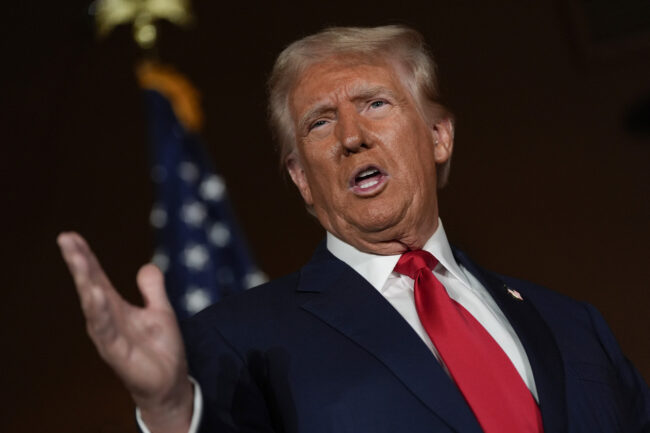
Former President Donald Trump is considering an ambitious trade policy if re-elected, proposing a universal tariff of 10 to 20 percent on all goods imported into the United States. This move, which could drastically impact the nation’s economy, has generated intense debate among trade experts and Republican lawmakers.
Trump’s Use of IEEPA to Impose Broad Tariffs
During his first term, Trump invoked rarely used laws to impose tariffs on steel and a range of Chinese goods. Now, if he wins a second term, experts believe he could rely on the International Emergency Economic Powers Act (IEEPA) to implement his latest trade proposal. This law, which grants the president extensive authority to control economic transactions after declaring an emergency, could serve as a legal foundation for Trump’s proposed tariffs, which currently impact over $3 trillion in annual imports.
Some trade analysts argue that IEEPA is versatile enough to support Trump’s pledge to phase out imports of essential goods from China over four years. This promise includes the potential imposition of a 60 percent tariff on Chinese goods, building on the duties he enacted during his first term.
Economic and Political Implications of Universal Tariffs
Critics, particularly free-market economists, warn that an across-the-board tariff would fuel inflation and raise the prices of everyday goods for American consumers. Vice President Kamala Harris, the Democratic nominee, has criticized Trump’s proposal, labeling it a “national sales tax” on American families.
Despite the opposition, legal experts acknowledge that IEEPA provides Trump with a credible legal pathway to enact his tariffs. Bill Reinsch, a former senior Commerce Department official, stated, “I’d argue it’s a perversion of the statute, but there’s pretty clear language in IEEPA that authorizes him to do that.”
While the Trump campaign has not clarified its implementation strategy, the use of IEEPA could allow Trump to bypass Congress, which has Constitutional authority over tariffs. Even with potential Republican control of Congress, securing broad support for such sweeping tariffs remains uncertain.
Historical Context and Legal Precedents
Trump is not the first president to contemplate using IEEPA for tariffs. In 2019, he nearly became the first to invoke IEEPA for this purpose when he threatened a 5 percent tariff on Mexican goods to curb illegal immigration. Additionally, in his 2023 book “No Trade is Free,” former U.S. Trade Representative Robert Lighthizer discussed efforts to use IEEPA to restrict Chinese investment in U.S. technology.
IEEPA has been invoked 69 times since its passage in 1977, with many of these declarations targeting specific countries like Iran and North Korea. However, Trump’s proposal to apply it to the trade deficit would be unprecedented and legally contentious.
Ed Gresser, a former U.S. Trade Representative official, pointed out that while the U.S. trade deficit has reached record highs, it has also declined as a percentage of GDP. This makes it challenging to argue that the trade deficit constitutes an emergency under IEEPA.
Potential Legal Challenges and Future Implications
If Trump proceeds with tariffs under IEEPA, companies affected could challenge the action in court. However, the chances of finding a judge to issue an injunction are slim, according to former White House official Everett Eissenstat. Legal battles could drag on for years, complicating the enforcement of the tariffs.
Trump’s use of IEEPA to address the trade deficit would be a bold move, testing the limits of presidential power. As the 2024 election approaches, this issue is likely to remain a key point of contention in both legal and political arenas.


COMMENTS