
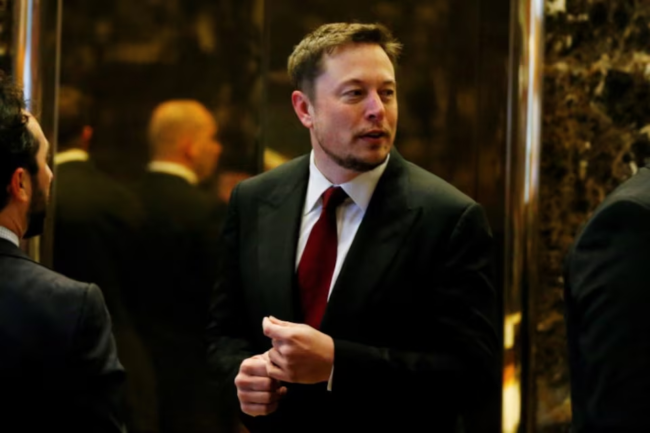
Tesla Chief Executive, Elon Musk enters the lobby of Trump Tower in Manhattan, New York, U.S., January 6, 2017. REUTERS/Shannon Stapleton/File Photo
Elon Musk’s Endorsement of Donald Trump Raises Questions About Policy Alignment
In a recent endorsement of Donald Trump for president, Tesla founder and CEO Elon Musk has aligned himself with a candidate whose policy positions starkly contrast with the core business interests of Tesla. Trump’s stance on energy, including his advocacy for expanding fossil fuel drilling, ending the electric vehicle (EV) mandate, and reducing subsidies, directly opposes the regulatory environment that has significantly contributed to Tesla’s rapid growth.
Tesla’s Reliance on Government Support
Tesla’s rise as the dominant EV manufacturer in the United States has been greatly aided by various forms of government support, including loans, tax incentives, and favorable regulatory policies. Despite Musk’s recent political shift towards Republican rhetoric, Tesla continues to lobby for policies typically championed by Democrats. For instance, in February, Tesla filed with the U.S. Environmental Protection Agency (EPA) to support California’s stricter vehicle emissions standards—a position directly opposed by Trump.
Earlier, Tesla advocated for regulations that would effectively ban the production of new gasoline-powered cars by 2035, a move criticized by many on the American political right. This apparent inconsistency in Musk’s public statements and Tesla’s lobbying efforts reflects a broader trend in Musk’s approach to business and politics.
Pragmatism Versus Ideology
According to Mike Murphy, a Republican strategist and head of the EV Politics Project, Musk’s public stance on subsidies contrasts sharply with Tesla’s reliance on them. While Musk has expressed hostility towards government subsidies, Tesla continues to benefit from such support. Insiders suggest that Musk’s pragmatic approach allows Tesla to take advantage of available public funds while maintaining an ideological opposition to government intervention.
Andrew Ward, a management professor at Lehigh University, noted that Musk’s broader ambitions, which extend beyond Tesla to sectors like artificial intelligence, space exploration, and neuroscience, may drive his willingness to align with political figures like Trump, even if it conflicts with Tesla’s immediate business interests.
Musk’s Shifting Political Allegiances
Musk’s relationship with Trump and the Republican Party has evolved over time. Initially critical of Trump’s environmental policies, Musk withdrew from White House advisory panels in 2017 after the administration exited the Paris Agreement. However, Musk later distanced himself from President Joe Biden’s climate initiatives, particularly after Tesla was excluded from a White House gathering of EV manufacturers in 2021.
Despite his criticism, Tesla has since praised the Inflation Reduction Act (IRA), a major stimulus package with provisions for clean energy subsidies. Tesla’s formal comments to the Treasury and the Internal Revenue Service indicate that the company intends to leverage the IRA’s benefits fully, including substantial tax credits for battery manufacturing.
The Economic Impact of Regulatory Credits
Tesla’s financial performance has also been bolstered by regulatory credits awarded by federal and state governments to manufacturers exceeding emissions standards. These credits, which can be sold to other carmakers, generated nearly $9 billion for Tesla since 2018. In the most recent quarter, Tesla earned $890 million from credit sales, contributing significantly to its $1.5 billion net income.
Despite Tesla’s ongoing lobbying for stricter emissions regulations, which increase the value of these credits, Musk has publicly echoed Trump’s sentiment against subsidies. This apparent contradiction has drawn criticism from some shareholders and former employees, who see it as a conflict between ideology and business pragmatism.
Environmental and Social Policy Positions
Tesla’s recent lobbying efforts continue to reflect a commitment to environmental goals that conflict with Trump’s policy positions. In July 2023, Tesla urged the EPA to implement stricter emissions limits, arguing that such measures are essential to addressing climate change and improving air quality in vulnerable urban areas.
Furthermore, Tesla has positioned itself as a leader in promoting diversity and inclusion within its workforce. However, this stance contrasts with Musk’s increasing disdain for identity politics and his criticism of the Democratic Party. In May 2022, Tesla highlighted its efforts to create an inclusive workplace in a filing with the California Air Resources Board, even as Musk publicly criticized the Democratic Party.


COMMENTS