
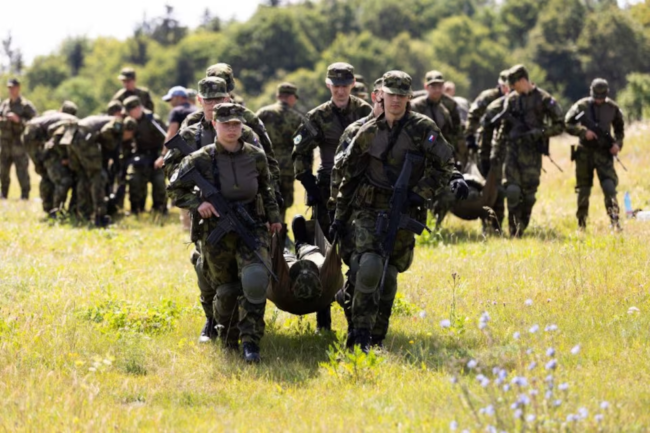
Volunteers undergo voluntary military training for students in the last years of high school, at the Hradiste military district near Alberice village, Czech Republic, July 29, 2024. REUTERS/Eva Korinkova/File Photo
Czech Army Struggles with Recruitment: A Broader Eastern European Challenge
A Bohemian Predicament
The Czech Republic, like many former Soviet-satellite states now part of NATO, is grappling with declining military enlistment numbers. This issue has become more pressing following Russia’s invasion of Ukraine, highlighting the potential threats to Eastern Europe. A new pilot program by the Czech army aims to address this shortfall by engaging young people in military training. However, despite these efforts, the Czech military continues to face significant challenges in recruitment and maintaining troop levels.
Pilot Program to Boost Enlistment
In an effort to attract more recruits, the Czech army has launched a pilot program where students participate in a four-week summer training camp, offering them a firsthand experience of military life. The program, conducted in a military zone 94 kilometers west of Prague, involves around 80 high school students who learn basic military skills, such as proper shooting positions and carrying combat rifles.
This initiative is spearheaded by the 4th Rapid Deployment Brigade, which operates at just 50 percent capacity due to a shortage of soldiers. General Karel Rehka, Chief of the Czech Armed Forces, acknowledges the unsustainability of the current system and emphasizes the importance of addressing the lack of human resources in the military to ensure national security.
Recruitment Shortfalls and Regional Challenges
The Czech Republic has struggled to meet its recruitment targets for years, with the country achieving only 56 percent of its recruitment goal in 2021, though this figure improved to 85 percent in 2022. This issue is not unique to the Czech Republic; other Eastern European nations, including Poland, Hungary, Romania, and Slovakia, face similar challenges. These countries, sharing borders with Ukraine, are particularly sensitive to the growing threat from Russia.
Despite modernization efforts in military equipment, General Rehka warns that without sufficient and motivated personnel, such investments are wasted. The shortage of recruits and the difficulty in retaining experienced soldiers are pressing concerns across the region.
Broader European Recruitment Issues
The recruitment challenges are not confined to Eastern Europe. Western European NATO nations also face difficulties in maintaining sufficient troop levels. NATO has recently acknowledged the need for an additional 35 to 50 brigades to strengthen its defense against potential Russian aggression. However, the problem is more acute in Eastern Europe, where memories of Soviet domination persist, and the threat from Russia is perceived as more immediate.
Former Czech Deputy Defense Minister Tomas Kopecny has expressed concerns about the possibility of Russian aggression within a few years, emphasizing the need for a reliable and adequately staffed military to respond to such threats.
Government Initiatives and Recruitment Strategies
In response to these challenges, governments across Eastern Europe have implemented various initiatives to attract new recruits. The Czech Ministry of Defense, for instance, has launched digital marketing campaigns, increased enlistment bonuses, and lowered medical requirements for new recruits and reservists. Despite these efforts, the competitive labor market in Eastern Europe makes it difficult to attract young people to the military, where salaries are often lower than in the private sector.
Poland, the largest country in Eastern Europe, has ambitious plans to expand its army to 300,000 soldiers. While the government claims to be meeting recruitment targets, critics question the feasibility of this goal. Poland has also launched a “Holidays With the Army” program, offering basic military training to citizens aged 18 to 35 over 28 days. However, despite an increase in recruits, a record number of professional soldiers—9,000—left the Polish army in 2023.
Hungary has adopted a different approach, using billboards, advertisements, and a military-themed TV series to attract new recruits. Meanwhile, Romania faces severe shortages in military personnel, with 43 percent of officer positions and 23 percent of soldier positions unfilled. The country has acquired advanced military equipment, such as Patriot missile defense batteries and F-16 fighter jets, but lacks the trained personnel to operate them.
The Future of Military Recruitment in Eastern Europe
Eastern European nations are placing their hopes on a new generation of soldiers to fill the ranks of their armed forces. Programs like the Czech army’s summer camp aim to instill a sense of pride and duty in young people, encouraging them to pursue military careers. Czech high school student John Dunka, a participant in the summer camp, expressed his enthusiasm for military service, highlighting the sense of pride that comes with wearing the uniform


COMMENTS