
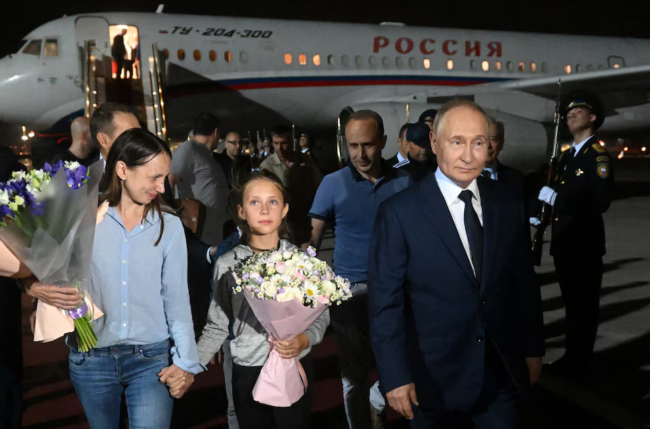
Russian President Vladimir Putin welcomes Russian nationals, including Artyom Dultsev, Anna Dultseva and their children, following a prisoner exchange between Russia with Western countries, during a ceremony at Vnukovo International Airport in Moscow, Russia August 1, 2024. Sputnik/Mikhail Voskresensky/Pool via REUTERS/File Photo
Russian Sleeper Agents and Largest East-West Prisoner Swap Since Cold War
Deep Cover Operations Revealed
A family of Russian sleeper agents, recently returned to Moscow in the most significant East-West prisoner exchange since the Cold War, were so deeply embedded that their children only discovered their Russian identity mid-flight, the Kremlin reported on Friday. Kremlin spokesman Dmitry Peskov explained, “Before that, they didn’t know that they were Russian and that they had anything to do with our country.” He noted that the children did not speak Russian and were greeted by President Putin in Spanish upon their arrival, with Putin saying “buenas noches.”
Details of the Swap
Peskov confirmed that Vadim Krasikov, a hitman freed by Germany, was an employee of Russia’s FSB security service and had served in Alpha Group, the FSB’s special forces unit. Krasikov was convicted by a German court for the 2019 assassination of a former Chechen militant in Berlin. President Putin personally greeted Krasikov, who was wearing a baseball cap and tracksuit top, highlighting his importance to Moscow, which values the return of intelligence operatives captured abroad.
The Dultsevs’ Story
Among those exchanged were the “illegal” sleeper agents, the Dultsevs, a husband and wife duo convicted in Slovenia for posing as Argentinians to conduct espionage. They were returned to Russia with their two children. Peskov disclosed that while in jail, the Dultsevs had limited access to their children and feared losing their parental rights. He recounted how the children, unaware of who Putin was, asked their parents about the person greeting them in Moscow. “This is how the ‘illegals’ work. They make such sacrifices out of dedication to their work,” Peskov remarked.
Ongoing Efforts and Government Response
Peskov mentioned that Russian agencies are actively working to secure the release of other Russians held abroad. The recent prisoner exchange was negotiated by the FSB and the U.S. Central Intelligence Agency. Putin’s decision to personally welcome the returnees was described by Peskov as “a tribute to people who serve their country and who, after very difficult trials, and thanks to the hard work of many people, have been able to return to the Motherland.”
Scope of the Exchange
The exchange involved 24 prisoners: 16 moved from Russia to the West, while eight prisoners held in the West were sent back to Russia. Among those released by Moscow were U.S. journalist Evan Gershkovich and Russian dissident Vladimir Kara-Murza, who also holds British citizenship. Despite Moscow releasing more prisoners than it received, the exchange was portrayed as a triumph by Russian authorities and was positively received by the public in Moscow.
Public and Political Reactions
Zulfia, a Moscow resident, expressed her satisfaction, stating, “I am not remotely political, but any way you look at it: any exchange is wonderful, that our Russian comrades returned to the motherland.” Andrei Lugovoi, a former spy wanted by Britain for the murder of dissident Alexander Litvinenko and currently head of an ultranationalist party’s faction in the Russian Duma, commented on Telegram, “Our people are at home with their families. And for each of them, it is no pity to hand over a bunch of foreign agent scum.”
Implications for Diplomatic Relations
When questioned about whether the prisoner swap indicated Russia’s readiness to negotiate a compromise on Ukraine, Peskov clarified that the situations are distinct. He stated that efforts toward a diplomatic resolution to what Russia terms its “special military operation” in Ukraine are being conducted on “different principles.”


COMMENTS