
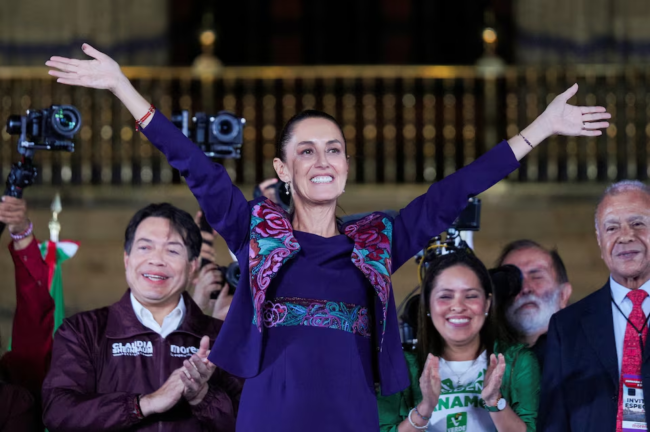
Morena party Claudia Sheinbaum, Mexico June 3, 2024. REUTERS/Alexandre Meneghini
Claudia Sheinbaum, a climate scientist and protege of Mexico’s outgoing President Andres Manuel Lopez Obrador, achieved a significant victory, becoming the country’s first female leader. Preliminary results from the electoral authority indicated Sheinbaum, a former mayor of Mexico City, secured 58.8% of the votes with 82% of the ballots counted, marking the highest vote percentage in Mexico’s democratic history. In her victory speech, Sheinbaum, a physicist and member of the United Nations panel of climate scientists awarded the Nobel Peace Prize in 2007, expressed gratitude to Lopez Obrador, describing him as “an exceptional, unique man who has transformed Mexico for the better.”
This victory represents a notable milestone for Mexico, a nation characterized by its traditional machismo and as the world’s second-largest Roman Catholic country. Sheinbaum’s election is also significant as she is the first woman to win a general election in North America, which includes the United States, Mexico, and Canada. However, the magnitude of her party’s triumph caused market concerns, as investors feared the ruling coalition might achieve a congressional super-majority, enabling them to pass controversial constitutional reforms without opposition.
Analyst Jacobo Rodriguez from Roga Capital noted, “It was precisely one of the scenarios that investors do not like.” By 11:30 am local time (1:30 pm ET) on Monday, the Mexican peso had depreciated by approximately 3.4% against the dollar, and the stock market had declined by 5%. Luis Maria Alcalde, the interior minister in Lopez Obrador’s cabinet, stated that the Morena party’s ruling coalition had secured a super-majority in the lower house of Congress but would be a few seats short in the Senate. Despite this, the coalition may require only a few opposition senators to enact constitutional changes, making such reforms plausible.
Concerns partly stem from Lopez Obrador, a prominent and polarizing figure in Mexican politics, who has significantly reshaped the country’s political landscape over the past six years. He framed the election as a referendum on his national project to “transform” Mexico. In February, Lopez Obrador proposed several constitutional reforms, including increasing pensions, mandating minimum wage hikes, and abolishing certain regulatory bodies, which investors viewed as radical and unsustainable. Although lawmakers rejected these plans, there are apprehensions that Sheinbaum might pursue similar reforms, including above-inflation minimum wage increases and electing judges by popular vote.
Lopez Obrador indicated on Monday that he would discuss advancing some reforms with Sheinbaum during his remaining tenure as president until the new lawmakers take office in September. Sheinbaum is set to assume office on October 1 for a six-year term. “We have to get on the same page to discuss these initiatives with Claudia, as well as other things we need to work on together,” Lopez Obrador stated. “I don’t want to impose anything.”
While Lopez Obrador’s tenure saw successes such as doubling the minimum wage, reducing poverty, and a strong peso, analysts suggest that Sheinbaum may find it challenging to follow in his footsteps. Despite rejecting opposition claims of being a “puppet” of Lopez Obrador, Sheinbaum has committed to continuing many of his policies, particularly those benefiting Mexico’s poorest citizens.
“There is an expectation that she will continue the policies of Lopez Obrador, but also become her own president at the same time,” commented Jason Marczak, senior director of the Atlantic Council’s Adrienne Arsht Latin America Center. Main opposition candidate Xochitl Galvez conceded defeat, having garnered only 28.1% of the votes with 82% of ballots counted, according to preliminary results.
Sheinbaum has vowed to expand welfare policies that bolstered Lopez Obrador’s popularity, a challenging task given the substantial budget deficit and low economic growth. She has also pledged to enhance security but has provided limited details. The election, noted for being the most violent in Mexico’s modern history with 38 candidates murdered, highlighted the country’s significant crime issues. Over 185,000 people have been killed during Lopez Obrador’s administration, although the homicide rate has been gradually declining.
“Unless she commits to making a game-changing level of investment in improving policing and reducing impunity, Sheinbaum will likely struggle to achieve a significant improvement in overall levels of security,” observed Nathaniel Parish Flannery, an independent Latin America political risk analyst.
U.S. President Joe Biden congratulated Sheinbaum on her “historic election” win. Sheinbaum’s administration will face several challenges, including negotiating with the United States over substantial flows of U.S.-bound migrants crossing Mexico and collaborating on security measures to combat drug trafficking, particularly during the ongoing U.S. fentanyl epidemic. These negotiations could become more complex if Donald Trump wins the U.S. presidency in November, given his vows to impose 100% tariffs on Chinese cars made in Mexico and to deploy special forces against drug cartels.
Domestically, Sheinbaum will need to address electricity and water shortages and attract manufacturers to relocate as part of the nearshoring trend, where companies move supply chains closer to their primary markets. Additionally, she will need to address the future of Pemex, the state oil company facing declining production and substantial debt. “It cannot just be that there is an endless pit where you put public money in and the company is never profitable,” remarked Alberto Ramos, chief Latin America economist at Goldman Sachs. “They have to rethink the business model of Pemex.”


COMMENTS