
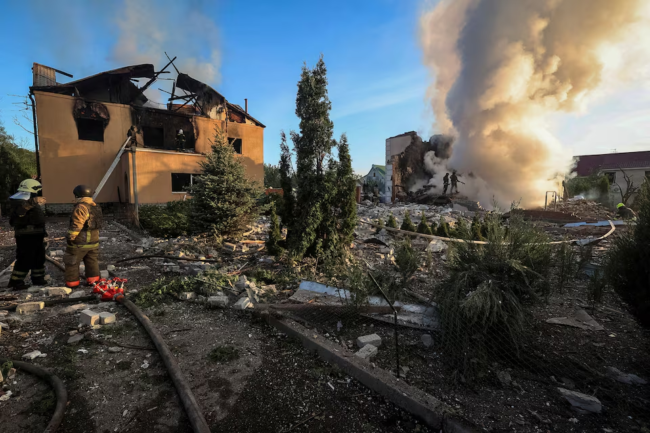
Firefighters work at a site of a Russian missile strike, amid Russia’s attack on Ukraine, in Kharkiv, Ukraine May 10, 2024. REUTERS/Vyacheslav Madiyevskyy
Russian forces initiated an armored ground offensive near Kharkiv, Ukraine’s second-largest city, on Friday, marking a new front in the ongoing conflict primarily concentrated in the eastern and southern regions of Ukraine. The incursion resulted in minor advancements by Russian troops, prompting Ukraine to deploy reinforcements to the contested border areas, as confirmed by the defense ministry. Reports indicated that Russia conducted aerial bombings and artillery strikes targeting the frontier town of Vovchansk.
Ukrainian President Volodymyr Zelenskiy addressed the situation during a news conference in Kyiv, characterizing the events as the commencement of a fresh wave of counteroffensive actions by Russia. He described the ongoing confrontations in the area as intense.
Prior to the offensive, Ukraine had raised concerns regarding a Russian military buildup in the region, speculating potential offensive maneuvers or diversionary tactics to engage and tie down Ukrainian forces already stretched thin. The extent of Moscow’s intentions regarding the offensive remained uncertain.
In its latest update, the Ukrainian General Staff revealed a concurrent buildup of Russian forces north of Kharkiv, in the vicinity of Sumy and parts of Chernihiv regions, marking an expansion of the conflict zone.
Zelenskiy conveyed apprehensions about the possibility of a significant offensive by Russia in the coming months, affirming Ukraine’s readiness to confront the recent assault while acknowledging the potential for further escalations.
According to the Ukrainian defense ministry, the Russian offensive commenced at approximately 5 a.m. The General Staff later reported ongoing battles aimed at thwarting Russian attempts to advance further into the Kharkiv region.
A senior Ukrainian military source disclosed that Russian forces had penetrated approximately 1 kilometer inside Ukrainian territory near Vovchansk. The source elaborated on Russian objectives, indicating an ambition to establish a buffer zone by pushing Ukrainian troops back as far as 10 kilometers within Ukrainian territory.
The White House acknowledged close coordination between the United States and Ukraine regarding the offensive in Kharkiv. Speculation arose regarding the potential for a broader assault on the city, although Ukrainian officials expressed skepticism regarding Russia’s capability to mount a successful operation to seize Kharkiv.
Battles for control over frontier villages, including Strilecha, Pylna, and Borysivka, intensified, according to the Ukrainian General Staff. Counteroffensive measures persisted in neighboring settlements, with ongoing engagements reported.
The situation remained dynamic, with fighting continuing into the evening hours, as indicated by military spokesperson Nazar Voloshyn. He suggested that Moscow’s objectives might include diverting Ukrainian forces from eastern fronts, where Russian offensives have been concentrated.
Regarding casualties, Kharkiv region governor Oleh Synehubov reported two civilian fatalities and five injuries resulting from heavy shelling of border settlements. Efforts were underway to assist civilians in evacuating affected areas.
President Zelenskiy provided an evening update, revealing reports of widespread heavy fighting across the extensive front line, spanning over 1,000 kilometers.
Following Russia’s full-scale invasion in February 2022, Ukrainian forces had previously expelled Russian troops from much of the Kharkiv region. However, Russian forces have resumed offensive operations after weathering a Ukrainian counteroffensive, particularly in the Donetsk region to the south.
Tensions escalated in March amidst concerns over the Kremlin’s intentions in the Kharkiv region, following Russian President Vladimir Putin’s call for the establishment of a buffer zone within Ukrainian territory. Putin cited the necessity of safeguarding Russia against shelling and border incursions.
The vulnerability of Kharkiv, given its proximity to Russia, has been underscored by sustained airstrikes targeting the region’s critical infrastructure in recent months. Despite Ukraine’s efforts, Russia maintains battlefield momentum, while Ukraine contends with manpower shortages and dwindling supplies of artillery ammunition and air defense resources.
This narrative presents a comprehensive and neutral overview of the recent developments in the Kharkiv region, avoiding emotive language and maintaining objectivity throughout


COMMENTS