
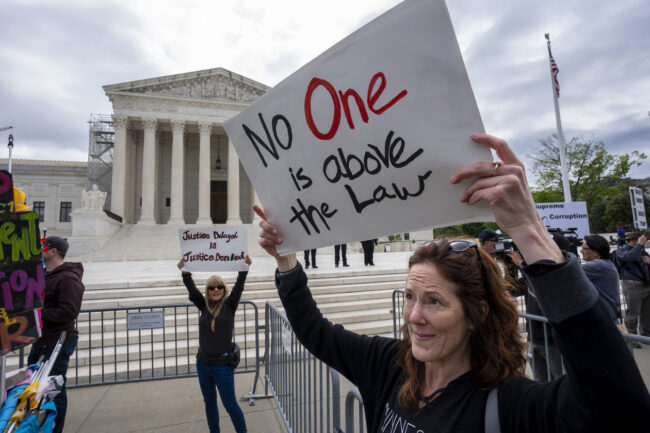
In a landmark case that could redefine the boundaries of executive authority, the Supreme Court is embroiled in a debate over presidential immunity. Former President Donald Trump’s claim of sweeping immunity from criminal prosecution has sparked intense scrutiny, challenging the court’s adherence to textualism and constitutional interpretation.
Conservative justices, typically staunch advocates for a strict textualist approach, find themselves navigating uncharted territory as they grapple with the absence of explicit presidential immunity in the Constitution.
Departure from Textualism
Trump’s lawyer argued that immunity was implied in the Constitution’s broadly worded clauses on presidential power. However, this departure from textualism drew criticism from both legal scholars and liberal justices, who highlighted the founders’ deliberate omission of immunity provisions. Instead of relying on textual clarity, the conservative bloc engaged in a balancing exercise, considering practical consequences and competing interests.
Justice Elena Kagan emphasized the lack of textual basis for presidential immunity, contrasting it with state constitutions that include immunity clauses. Critics argue that the court’s potential creation of a legal protection for former presidents based on subjective assessments diverges from originalist principles.
The Debate Continues
While the court’s conservative justices grappled with the absence of textual support, they did not entirely abandon textualism. Justice Clarence Thomas’s inquiry sought precision on the source of immunity, reflecting a commitment to textual analysis. However, Trump’s lawyer failed to provide a convincing textual basis, resorting to broad interpretations of executive power.
The debate over presidential immunity underscores broader tensions within the court’s interpretive framework. While legal precedent and structural checks inform decision-making, the absence of textual guidance poses challenges. The court’s forthcoming ruling on Trump’s immunity claim will likely shape future interpretations of executive authority and constitutional limitations.
Conclusion: Navigating Constitutional Interpretation
The Supreme Court’s deliberations highlight the complexities of constitutional interpretation and the evolving nature of legal principles in modern jurisprudence. As the nation watches, the court’s decision will not only impact the fate of Trump’s legal battles but also shape the contours of presidential power for generations to come.


COMMENTS