
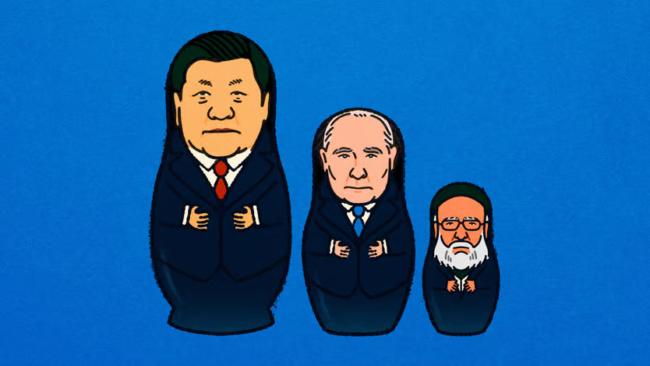
Illustration: Alberto Miranda via The Economist.
Vladimir Putin, the President of Russia, and Ebrahim Raisi, his counterpart in Iran, share several similarities. Both leaders are among a select few targeted by American sanctions. Despite their limited travel, both have visited China in recent years and have exhibited a growing affinity for each other. In December, they convened at the Kremlin to discuss the conflict in Gaza, and on March 18th, Mr. Raisi promptly extended congratulations to Mr. Putin on his decisive election victory.
Historically, relations among Russia, Iran, and China have been marked by competition rather than camaraderie. These countries, with imperialist tendencies, frequently interfered in each other’s spheres of influence and competed for control over trade routes in Asia. However, recent developments, particularly actions by the United States, have altered this dynamic. In 2020, the U.S., following its withdrawal from a nuclear deal with Iran, reinstated trade sanctions on the country. Additional penalties were imposed in January, targeting Iran’s support for groups like Hamas and Houthi rebels. Russia, too, faced sanctions from the West in 2022 after its incursion into Ukraine, which were subsequently intensified. Furthermore, China has encountered its own set of restrictions, with the potential for more stringent measures should certain political outcomes occur in the United States. In response to these common challenges, the three nations have pledged to pursue a unified foreign policy aimed at promoting a multipolar world order not dominated by the United States. They view strengthened economic ties as a cornerstone of their alliance.
China has pledged an unrestricted partnership with Russia and signed a strategic agreement with Iran spanning 25 years in 2021. All three countries are members of multilateral organizations such as BRICS, and their bilateral trade is on the rise. Plans are underway to establish tariff-free blocs, new payment systems, and alternative trade routes to circumvent Western-dominated channels. While this alignment is viewed unfavorably by the United States and its allies, who fear its potential to evade sanctions, win conflicts, and recruit other adversarial actors, the extent and implications of this alliance remain uncertain.
Economic cooperation, particularly in the realm of commodity trade, has witnessed significant growth among these nations. China, a major importer of oil from petrostates like Iran and Russia, has seen increased imports from Russia following Western sanctions. Similarly, Iran’s exports to China have surged, albeit facing constraints due to secondary sanctions. Despite their interdependence in energy trade, China’s broader economic leverage allows it to negotiate advantageous terms with its allies. For instance, China procures Russian and Iranian oil at discounted rates and processes these resources into higher-value products, bolstering its petrochemical industry.
Expanding commodity trade is just one facet of the evolving relationship among Russia, Iran, and China. China has substantially increased its exports to Russia, especially in high-value manufacturing goods, while Iran faces challenges in accessing critical raw materials and technology due to sanctions. Efforts to deepen economic ties between Russia and Iran are hampered by limited investment, with China’s investment in Iran remaining relatively modest. Russia’s expectation of Chinese support for key projects, such as the Power of Siberia 2 pipeline, has yet to materialize, contributing to uncertainties in their partnership.
While the alliance has provided resilience against Western sanctions, particularly for Iran and Russia, challenges persist in maximizing its potential. Efforts to foster cross-border investment and trade agreements have been hindered by bureaucratic hurdles and investment constraints. Additionally, the similarity of Russia’s and Iran’s economies limits the scope for complementary trade relations. Competition, rather than cooperation, characterizes their energy trade, with Russia enjoying a competitive edge due to its exemption from secondary sanctions. Furthermore, China’s economic dominance poses challenges to Iran’s manufacturing sector, exacerbating its dependency on oil exports.
As the anti-Western alliance navigates external and internal challenges, its trajectory remains uncertain. While it serves China’s interests in the short term, the extent of its transformation into a full-fledged partnership hinges on various factors, including geopolitical developments and shifts in global trade dynamics. Despite its potential, the alliance is likely to remain subordinate to China’s strategic objectives, with member nations balancing their interests against the risks of antagonizing Western powers.


COMMENTS