
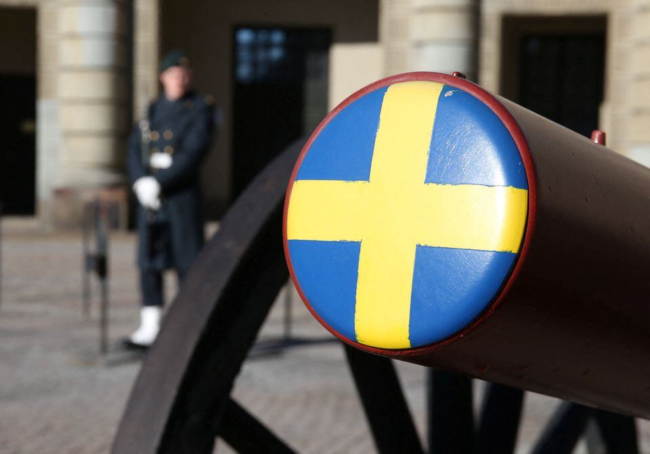
A Swedish soldier stands next to a ceremonial cannon in the courtyard of the Royal Palace in Stockholm, Sweden, March 7, 2024. REUTERS/Tom Little
Sweden officially joined NATO in Washington on Thursday, following a two-year reconsideration of its national security strategy prompted by Russia’s invasion of Ukraine. This decision reflects Sweden’s assessment that alignment with the alliance provides the most robust safeguard for its security.
Prime Minister Ulf Kristersson finalized the accession process by submitting the requisite documentation to the U.S. government. U.S. Secretary of State Antony Blinken welcomed this development, emphasizing its historical significance for Sweden, NATO, and the transatlantic relationship.
The inclusion of Sweden and Finland, with their extensive border shared with Russia, represents a significant enlargement for NATO, marking one of the most substantial expansions in decades. This move also carries implications for Russian President Vladimir Putin, who has consistently opposed NATO’s reinforcement.
Prime Minister Kristersson hailed the occasion as a pivotal moment for Sweden, highlighting the alignment of the nation’s core values with those of NATO, particularly emphasizing democracy, liberty, and the rule of law.
Sweden stands to benefit from NATO’s collective defense commitment, wherein an attack on one member is perceived as an attack on all. Citizens, such as 54-year-old IT worker Hakan Yucel, anticipate decreased tensions and enhanced security following Sweden’s accession.
From a military standpoint, Sweden’s addition to NATO brings advanced submarines and a significant fleet of domestically produced Gripen fighter jets to the alliance, reinforcing its strategic position between the Atlantic and Baltic regions.
Russia has responded to Sweden’s decision with threats of unspecified “political and military-technical counter-measures.” This underscores the geopolitical ramifications of Sweden’s alignment shift.
Analysts, including Barbara Kunz of the defence think tank SIPRI, liken Sweden’s NATO membership to purchasing insurance, contingent upon the willingness of the United States to fulfill its role as a security guarantor.
While Sweden has incrementally gravitated towards NATO over the past two decades, membership represents a definitive departure from its longstanding tradition of neutrality and non-alignment in armed conflicts, which endured for over two centuries.
Post-World War Two, Sweden garnered international recognition as a proponent of human rights, with subsequent administrations scaling back military expenditures following the collapse of the Soviet Union in 1991.
The decision to pursue NATO membership came after initial reluctance, with the defense minister rejecting the notion as recently as 2021, only for subsequent governments to reverse course and apply for membership alongside Finland.
Sweden’s accession process faced delays as Turkey and Hungary, both maintaining amicable relations with Russia, postponed ratification. Turkey ultimately approved Sweden’s application in January, while Hungary awaited Prime Minister Kristersson’s visit to Budapest on Feb. 23, culminating in a bilateral agreement on fighter jet procurement.


COMMENTS